Wide-span buildings with reinforced concrete columns and a steel roof are very common, mainly for economic reasons. The two element types differ from each other in many respects, so unusual behaviour is unavoidable at their connections and in the system as a whole.
This article looks at how an example system responds to earthquake loading: a roof truss with a 30 m span sitting on 8 m high reinforced concrete columns.
The support conditions change the period of the structure, and the period in turn changes the displacements, accelerations, reactions and internal forces during an earthquake.
Three ways to model the same building
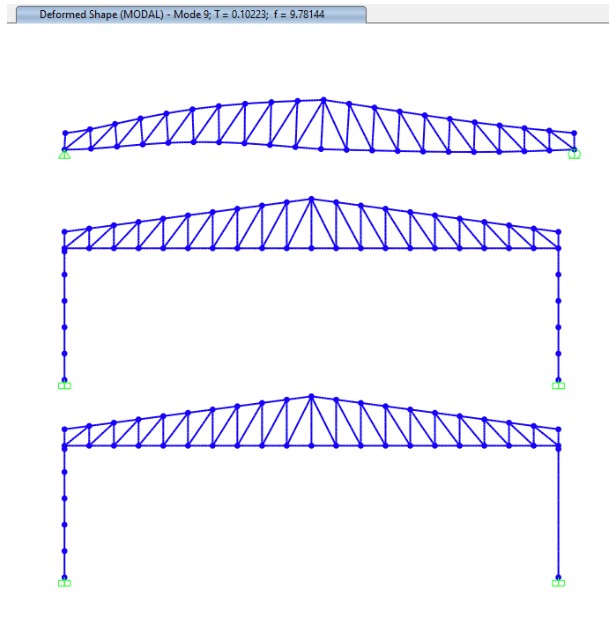
Case 1 — roof solved on its own. One bearing fixed, the other sliding. Mode 1: T = 0.44 s, vertical.
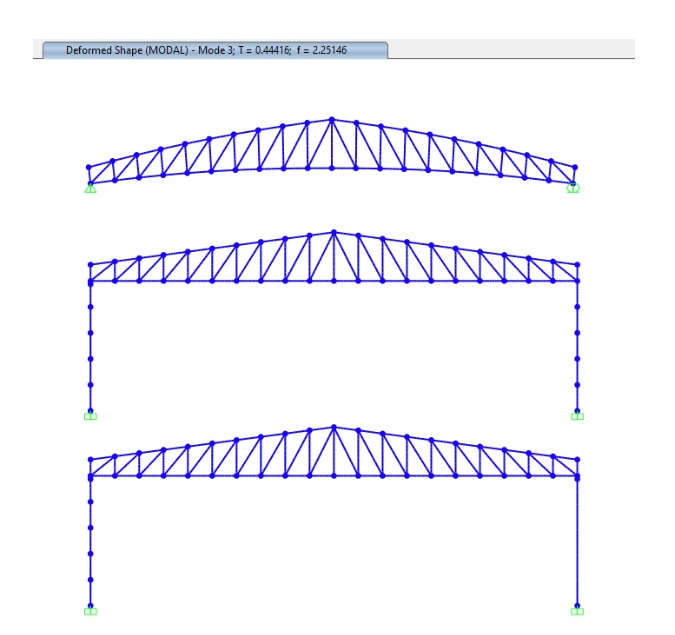
Case 2 — roof solved together with the columns. Both bearings fixed, column tops free of moment. Mode 1: T = 0.54 s, horizontal.
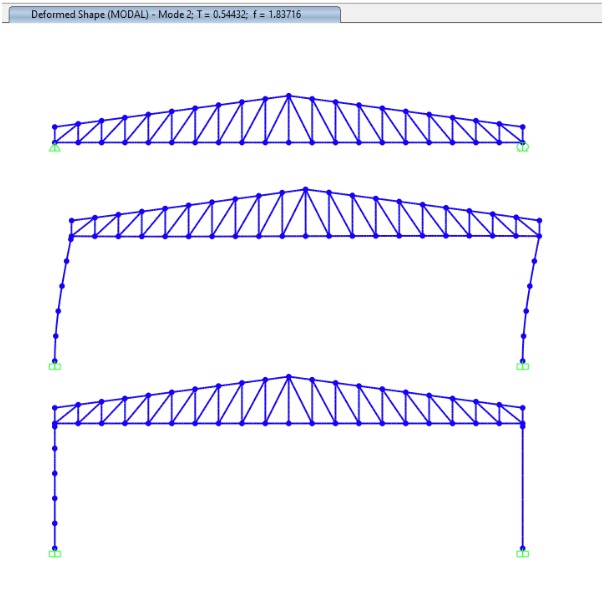
Case 3 — roof solved together with the columns. One bearing fixed, the other sliding, column tops free of moment. A link element on the right column lets the steel roof move horizontally independently of the column. Mode 1: T = 0.77 s, horizontal.
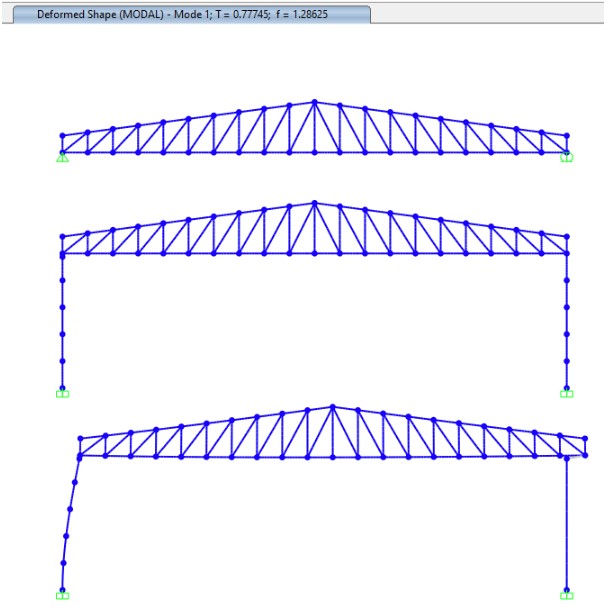
As seismic codes also stress, vertical earthquake motion on wide-span roofs has to be taken into account, at least with the modal combination method. The vertical period of the truss in Cases 2 and 3 is the same as in Case 1, so all three systems can be expected to behave similarly in the vertical direction.
If a material with relatively low vertical stiffness, such as an elastomer, is used at the column–truss interface, the periods will lengthen.
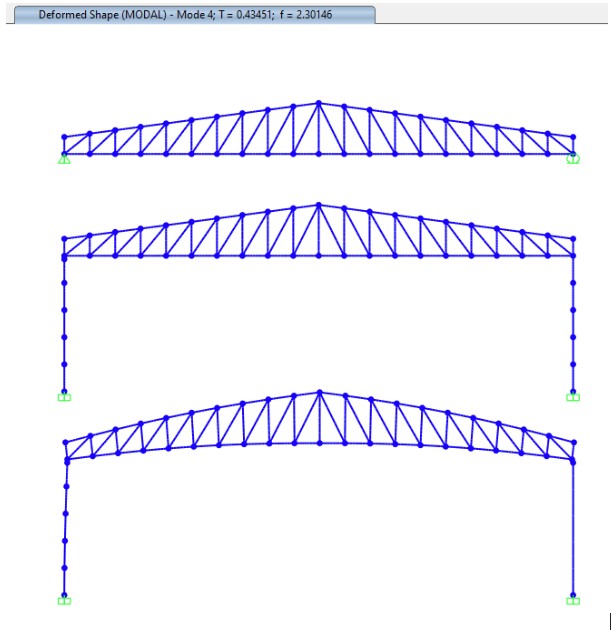
Case 1 is the common practice in the industry: the concrete frame and the roof are solved separately and then put together. Its first horizontal period is T = 0.1 s, so both the equivalent lateral force method and the modal combination method would have to work with the maximum values of the horizontal elastic design spectrum.
Dynamic load with a 1 s period
To see the dynamic response of the three models, a horizontal dynamic load with a period of 1 s was applied.
Horizontal displacement at the sliding bearing
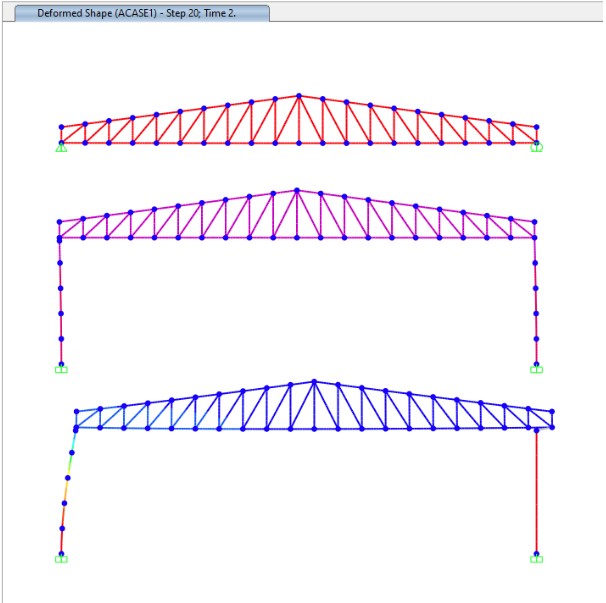
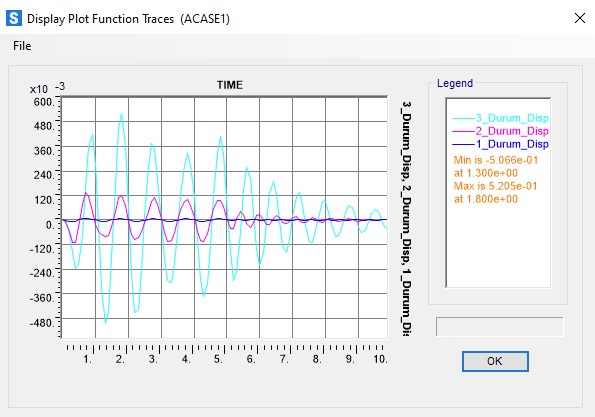
Case 3, whose natural period is closest to the period of the applied force, displaces far more than the others. Case 1, whose horizontal period of 0.1 s is the farthest from it, displaces the least.
So if the system is split into parts and solved as in Case 1, with one bearing designed as sliding, the displacements are on the unsafe side compared with Case 3. The left column, which has to resist the entire horizontal force on its own, is already well into the nonlinear range at a drift of about 6%. Case 2, with both bearings fixed, gives results closer to Case 1.
Horizontal reaction at the fixed bearing — shear at the top of the left columns
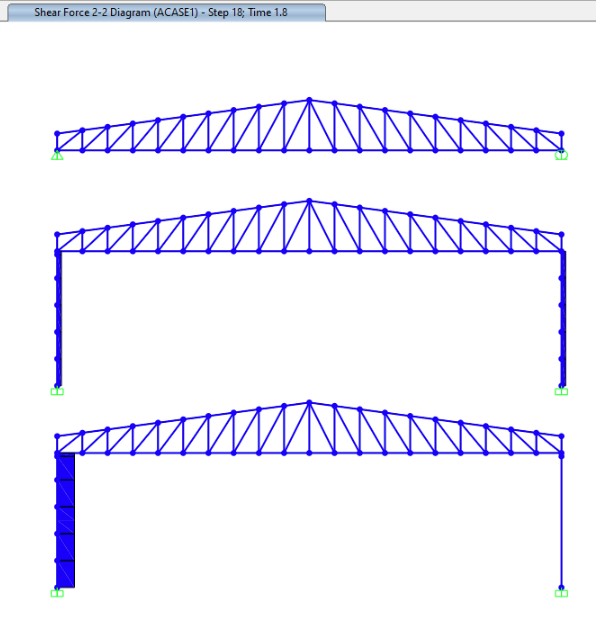
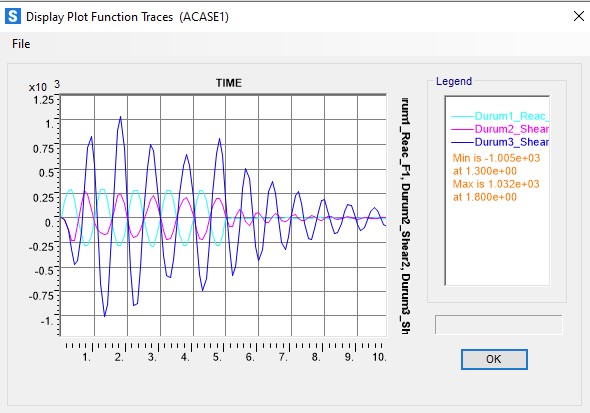
In Case 3, on top of the period effect, the entire shear goes to a single column. In Cases 1 and 2 the values are very close to each other.
Acceleration at the roof ridge
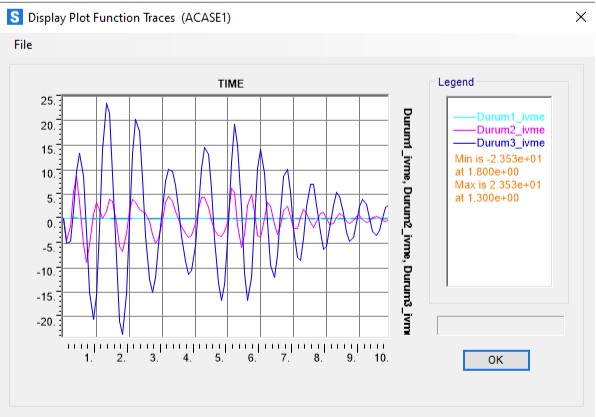
The accelerations show that the roof barely moves in Case 1. The acceleration in Case 3 is about twice that in Case 2, even though their natural periods are not very different. In Case 3 it reaches about 2.5 g.
Dynamic load with a 0.2 s period
Alternatively, the horizontal dynamic load was applied with a period of 0.2 s, closer to the period of Case 1.
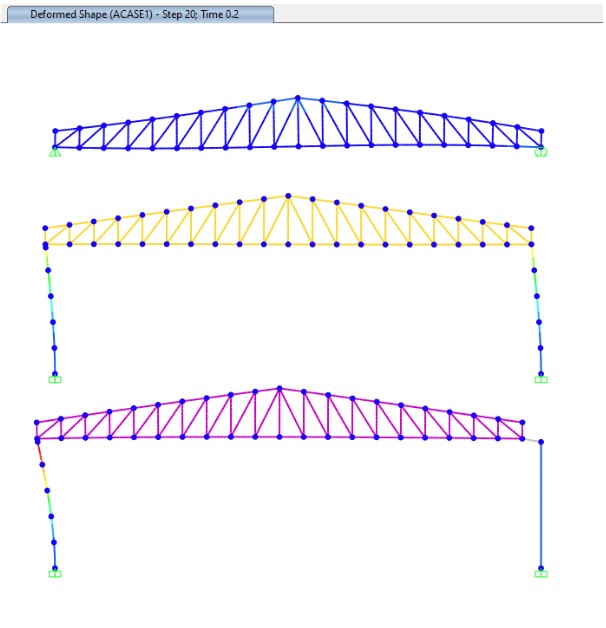
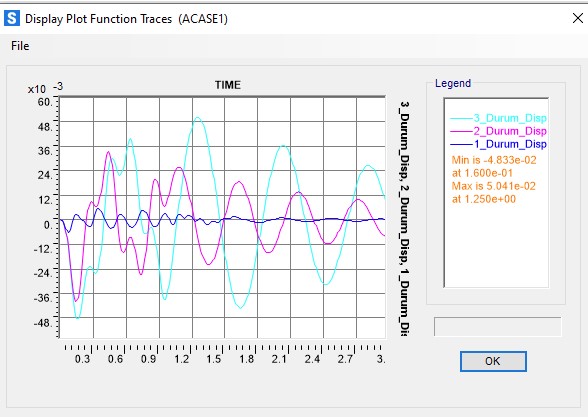
Case 1 again displaces the least, while Cases 2 and 3 are closer to each other. The 480 mm displacement of Case 3 under the 1 s loading drops to roughly one tenth.
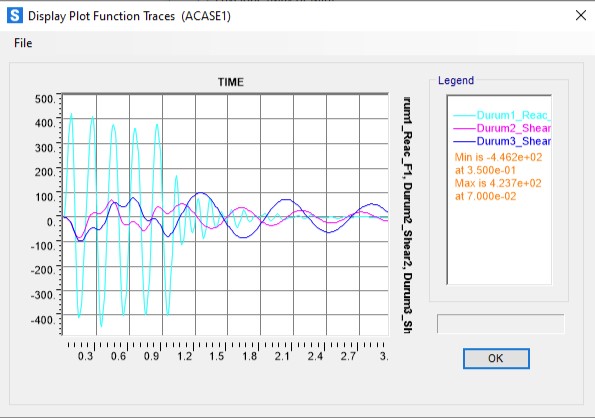
The horizontal reaction in Case 1 almost doubles, the shear in Case 2 halves, and in Case 3 it drops to about one tenth.
By these figures, if a structure that really behaves like Case 3 is designed with the roof and the columns solved separately, the 0.2 s loading overestimates the shear forces about 4 times and underestimates the displacements about 4 times.
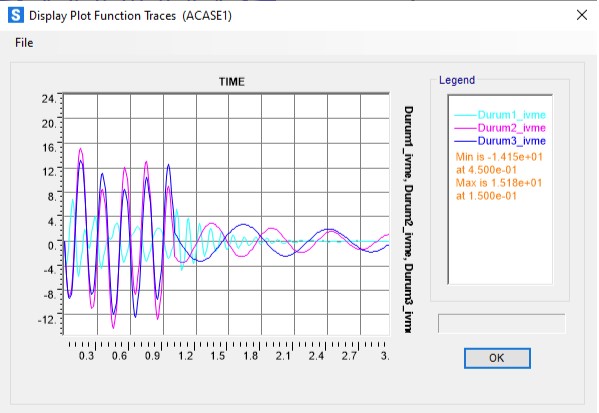
Compared with the 1 s loading, the accelerations increase in Case 1 and decrease in Cases 2 and 3.
Modal combination (response spectrum) method
With SDS of about 1 g, the response spectrum method gives the following.
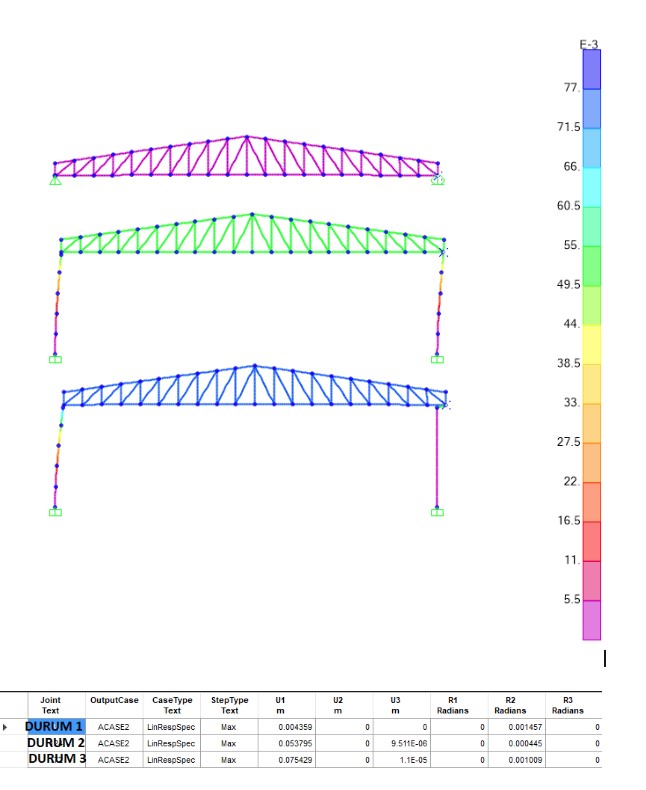
The displacement in Case 3 is about 19 times that of Case 1, and in Case 2 about 14 times.
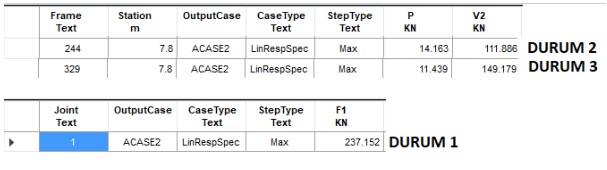
The shear in Case 1 is twice that of Case 2; Cases 2 and 3 are close to each other.
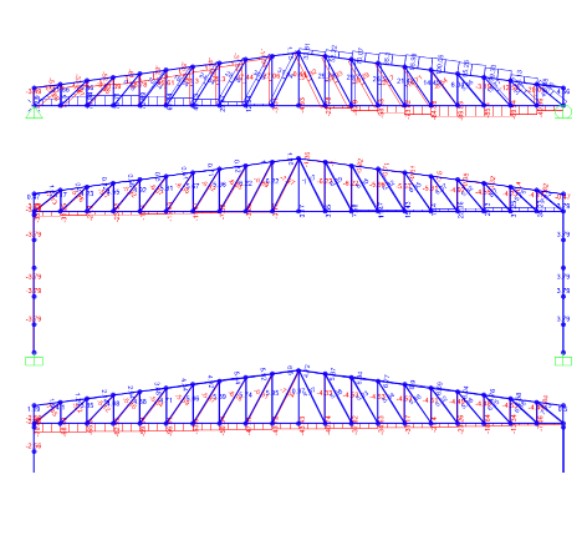
In the truss axial forces, Case 1 gives four times the internal force of Case 2. Cases 1 and 3 reach a similar maximum compression in the bottom chord, but the shape of the axial force diagram is quite different.
Conclusion
Including the columns in the model, and the choice of support conditions, changes every design value. As seismic codes also require, the right approach is to model the system as a whole, as close to the real situation as possible. The columns and the steel roof have to be compatible not only in loads but also in displacements.
Under ASCE 7, the forces on roof-level elements that are independent of the structural system are around 0.85 SDS·W. For connections to reinforced concrete they are multiplied by an overstrength factor of 2, and with an importance factor of 1.5 they can reach the code’s upper limit of 1.6 SDS·Ip·Wp = 2.40 SDS·W (ASCE 7-16, Eq. 13.3-2).
The forces on the roof should therefore not be reduced by R; for the connections to the reinforced concrete they should even be increased.
The steel truss to concrete column connection
All of this lands on one detail: the bearing where the steel truss sits on the concrete column. Whether it is fixed or sliding sets the period, and its anchors have to carry the amplified forces above, not forces reduced by R. A small change in a connection detail is also how the 1981 Hyatt Regency walkways fell: One rod became two.
Real connection checks: a library of checked steel connections, each with its stress plots, utilisation and a 3D model, and what a full calculation report looks like. Need this connection designed? Steel connection design and calculations, outsourced.
Related case study: A crane canopy: three support decisions and the traps between them — on a real crane canopy the support condition decided the wind drift (22.6 mm pinned, 3.9 mm fixed) and, in the end, the anchors.
Originally published in 2022; revised in 2026.