Igor Beresnev did not want to wait for research funding or for fresh data from the next big earthquake. He spent many summers and weekends analysing current and historical records, and he now believes he has found an upper limit for earthquake ground acceleration.
Between 1971 and 2011, earthquakes kept surprising seismologists with ever larger accelerations. Before 1971, scientists believed that ground acceleration could not exceed 0.5 g. (g is the acceleration of gravity, about 9.81 m/s². A car that goes from 0 to 100 km/h in 10 seconds accelerates at 2.78 m/s², or 0.28 g.)
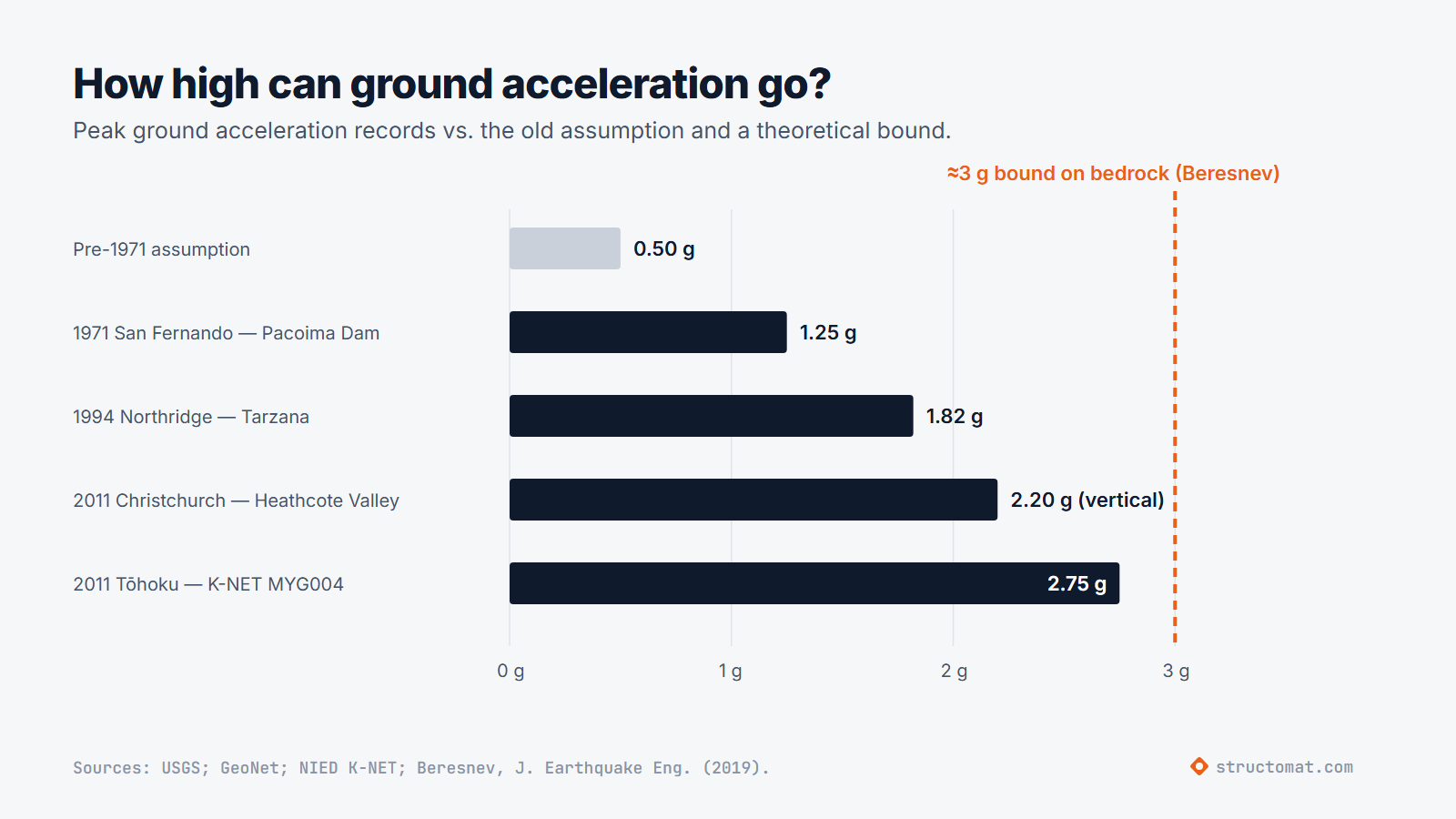
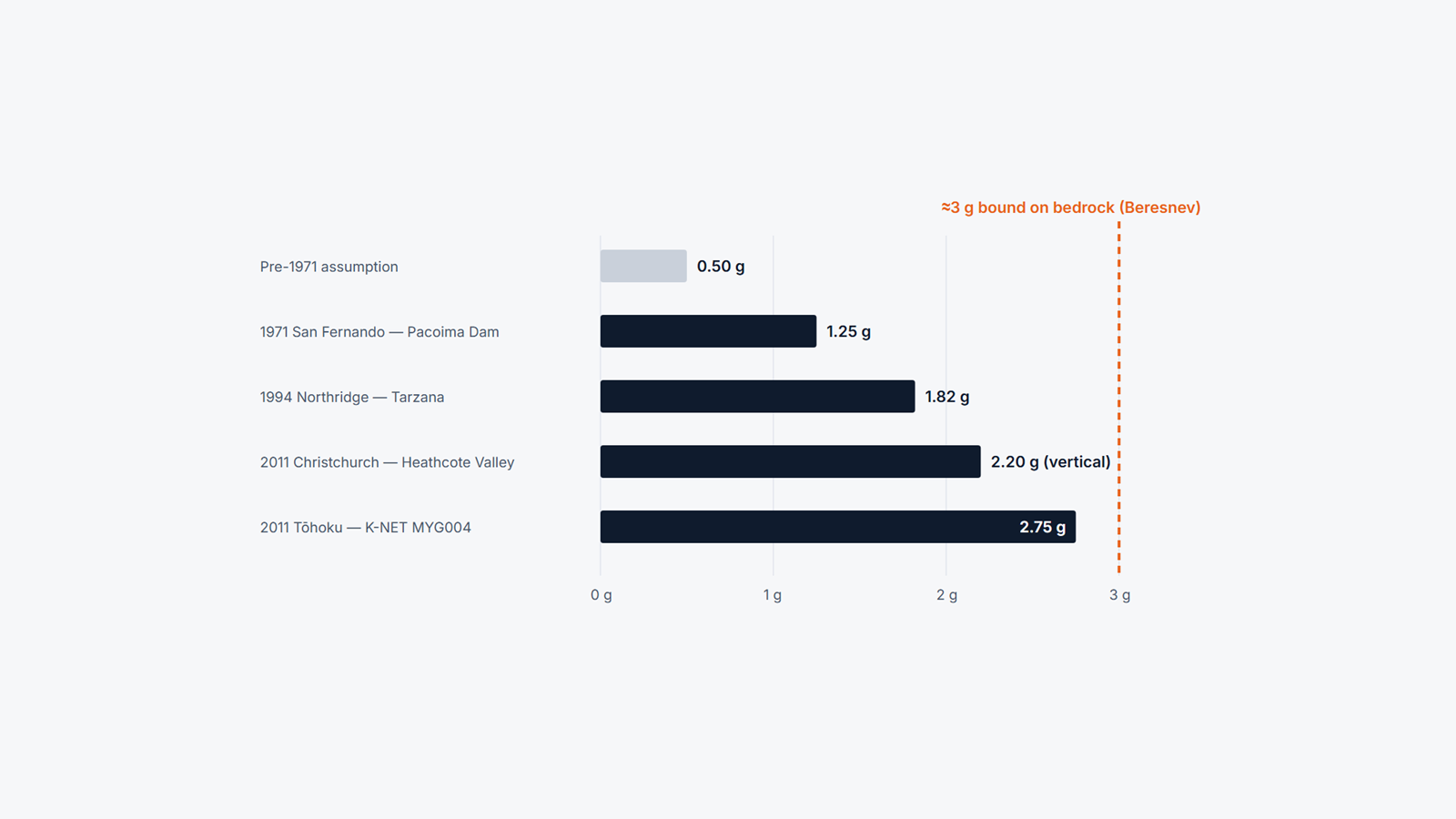
- 1971 San Fernando, California: 1.25 g at Pacoima Dam, like a car doing 0–100 km/h in 2.3 seconds.
- 1994 Northridge, Los Angeles: 1.82 g at Tarzana, 0–100 km/h in about 1.6 seconds. No production car accelerates like that.
- 2011 Christchurch, New Zealand: a moderate magnitude-6.3 event produced 2.2 g, in the vertical direction.
- 2011 Tōhoku, Japan: about 2.7 g at the K-NET station MYG004.
“2011 was the year that changed the game,” Beresnev said. For engineers designing earthquake-resistant structures these values are precious: will the records keep being broken, or is there a limit?
Is there a limit?
Beresnev, who teaches geology, applied geophysics, seismic methods and meteorological instrumentation, has worked on predicting earthquake ground motion since the late 1980s. His approach relies on data from modern instruments, available since the 1960s, and on the basic quantities of an earthquake rupture, such as the amount and speed of slip. Ground motion faster than about 2 m/s has never been observed. Putting this value into the equations that govern seismic wave propagation, he set the upper limit of acceleration on bedrock at about 3 g, roughly the peak acceleration a Space Shuttle crew felt during launch.
He tested his calculations by reproducing the records of the Lucerne Valley station of the Southern California Seismic Network during the 1992 Landers earthquake; that station sat almost on top of the fault rupture. His work also shows a disconnect between magnitude and acceleration: high ground accelerations do not need a magnitude-9 event. A magnitude 5 or 6 earthquake can produce large accelerations and damage, even if over a smaller area.
Sources: Iowa State University News (2018); I. Beresnev, “The Strongest Possible Earthquake Ground Motion”, Journal of Earthquake Engineering.
Related notes: Steel Building Performance Analysis · Lead Rubber Bearing (LRB) Isolator · Triple Friction Pendulum Seismic Isolator · The Concept of Envelope Combinations and Their Limitations
Originally published in 2021; revised in 2026, with record values checked against station data.