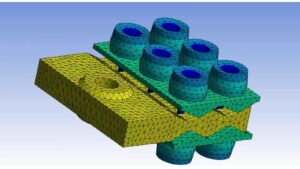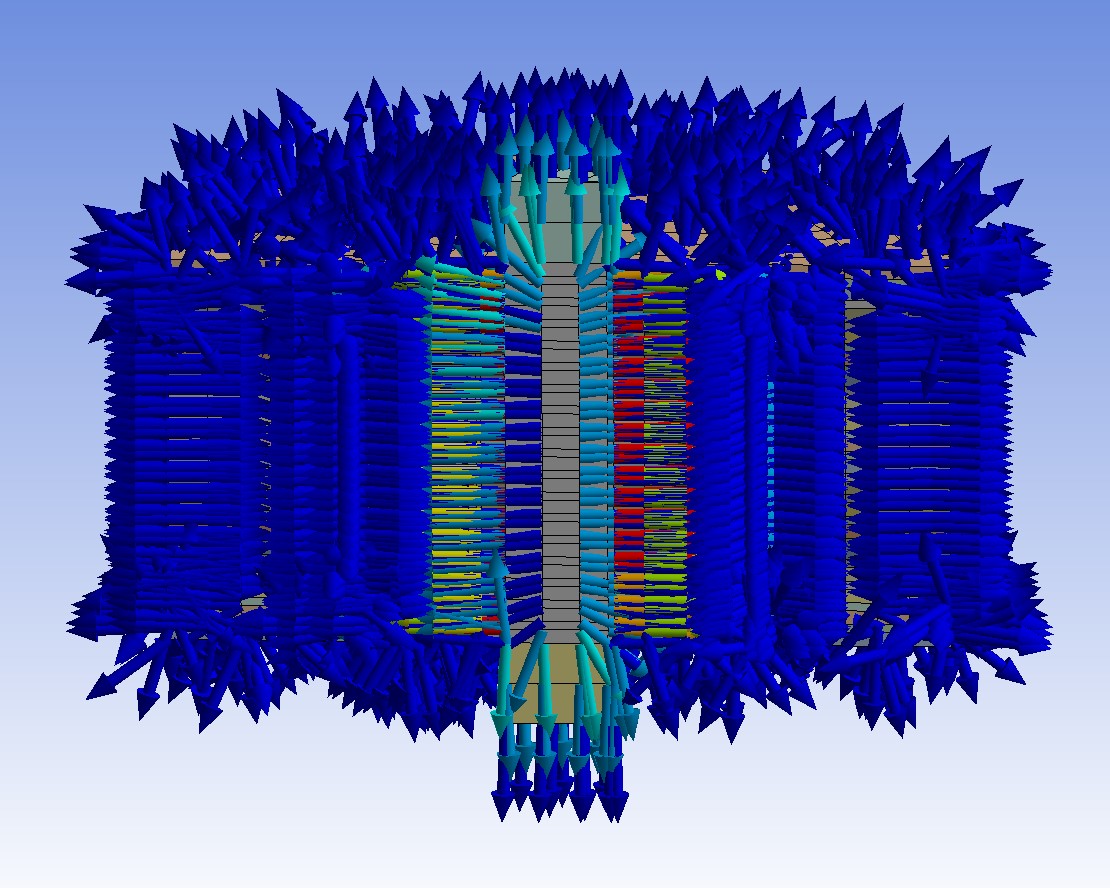
This simulation looks at how a lead rubber bearing moves, using the finite element method.
The lead rubber bearing was invented in 1975 by the New Zealand mechanical engineer W. H. Robinson. It is made of steel-reinforced rubber layers and steel plates, with a lead block in its core.
Some time after earning his mechanical engineering degree, Bill Robinson decided that he could not make products of the quality he wanted without knowing materials better, so he went on to study metallurgical engineering as well.
It is said that before inventing the lead rubber bearing he shut himself in his office with the periodic table for a year, looking for the element to fill the hole in the middle of the bearing.
Once invented, the bearing found its way into many projects and many different types of structure.
Robinson died at 73. On what would have been his 81st birthday, Google published a doodle in his honour.

Lead, rubber and steel
Lead was once a popular element. Although its harm to living things had been known for a thousand years, it was found in everything from petrol and paint to batteries and glass.
Its melting point is far below that of steel, so it can be worked easily even at room temperature, and it is one of the heaviest metals; these are a few of the reasons for its popularity. Its strength, however, is quite low.
The rubber used in bearings is a hyperelastic material. Its stress–strain curves are nonlinear, yet even after very large displacements it returns elastically to its original shape when the load is removed. Its behaviour is therefore nonlinear but elastic.
Many researchers have proposed different models to reproduce these nonlinear stress–strain curves. Engineers know this variety of models from soils, whose rather complex behaviour is also expressed with nonlinear springs.
Alongside these materials of low strength and stiffness, steel is used wherever strength and stiffness are needed.
Heat in the lead core
During strong ground motion, when the waves created by the movement of tectonic plates reach the bearing, the planes formed by the lead crystals first slip past each other at the atomic level and then start to rub. Friction produces heat, and the temperature of the lead begins to rise. In a large bearing this rise can reach 100–150 °C, approaching the melting point of lead.
The lead is completely enclosed by steel plates above and below and by rubber layers around its sides. Rubber conducts heat very poorly, so the heat cannot easily escape sideways. It flows out through the top and bottom plates, into the air and into the structural members the plates are fixed to.
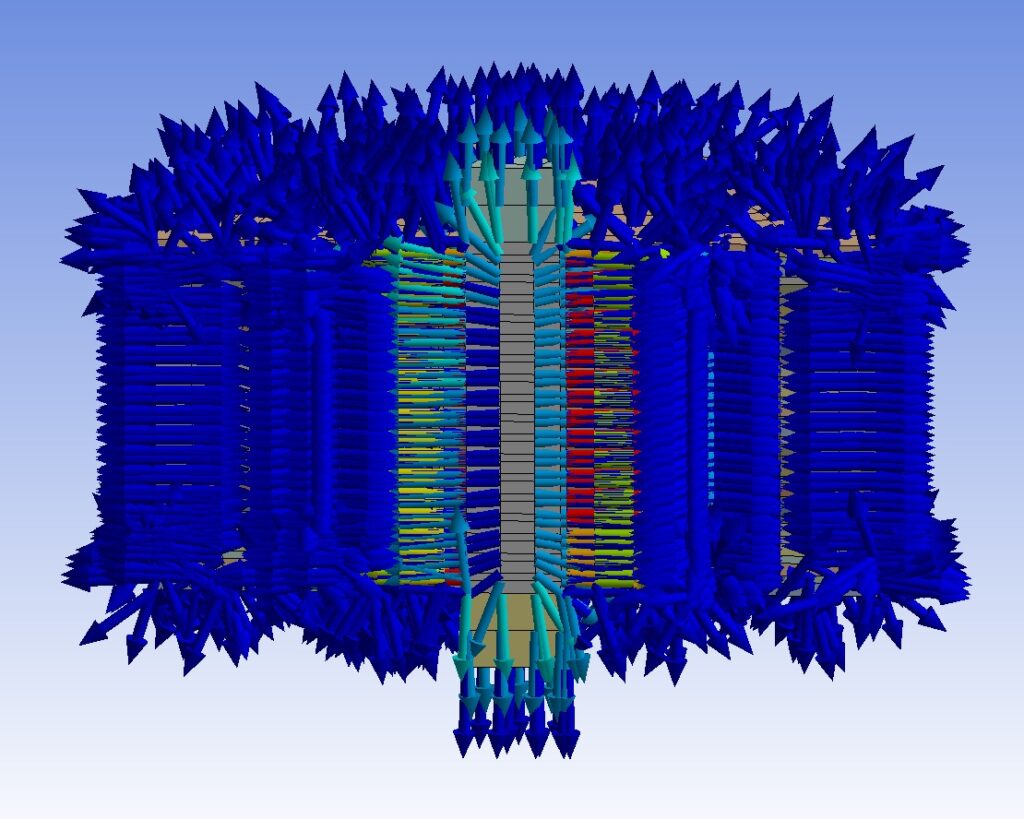
The heat of the molten metals in the Earth’s core has turned first into the motion of tectonic plates, and then back into heat inside the bearing.
A bearing that weakens with every cycle
As the lead heats up, its yield strength drops. Its resistance to horizontal movement falls, because at the atomic level the bonds between the crystals have broken and the crystals are scattered. With every cycle, the bearing’s ability to dissipate energy decreases.
While the core resists the horizontal load, the rubber layers carry the vertical load, and in extreme cases they undergo shear strains of 150–200%. For comparison, steel is taken to fracture at about 17% elongation in tension, and concrete is finished at just 0.5% compressive strain.
With every cycle the bearing loses strength not only horizontally but vertically as well. Because of second-order effects as it displaces sideways, its vertical stiffness can drop to one fifth of its value in the upright position.
How the bearing behaves at the next moment depends on what it has been through before and during the earthquake, and on the motion of the structure above and the ground below: its behaviour is hysteretic. If maximum vertical tension or compression arrives at the moment of maximum horizontal deformation, the stresses and strains in the rubber, lead and steel change, the next movement is shaped by that, and a solid punch at its weakest moment may knock the bearing out.
What tests can miss
Some bearing test rigs cannot reproduce this dynamic situation. Loading protocols usually check the maximum vertical load capacity for the non-seismic case, and for the seismic case fix the vertical load at a set value and check the horizontal displacement capacity under it. Some test centres even lock the vertical movement of the bearing completely.
Rigs that cannot apply horizontal and vertical loads dynamically and at the same time may miss failure modes caused by hysteretic behaviour in a real earthquake. The result can be bearings that are damaged and put out of service by an earthquake much smaller than the ground motion they were designed for.
A well-designed, tested and installed bearing, on the other hand, will take all the displacement and dissipate the energy itself in the largest possible ground motion, keeping the structure it carries away from the hazard coming from the ground.
Related notes: Triple Friction Pendulum Seismic Isolator · Viscous Damper Reinforced Building Analysis and Design · Resilient Slip Friction Joint · Steel Building Performance Analysis
Originally published in 2022; revised in 2026.