The critical damping ratio is one of the most important properties governing how a structure responds to dynamic actions, yet even in 2021 it carries a great deal of uncertainty. For the same structure, different sources suggest three percent, five percent, two percent, or neglecting it altogether. Structures are known to have some inherent damping, but it cannot be calculated mathematically, so values based on past experience and tests are used.
Another source of uncertainty is that a structure has a different damping capacity in service than under actions close to its ultimate capacity. For the five percent damping that codes generally recommend for reinforced concrete structures to develop, the structure must be damaged at predetermined locations. Damping depends on the damage state, which is itself full of uncertainty.
Engineers who want to assess the performance of their structures more accurately, and raise it, decided to build their own damping mechanisms instead of relying on the three-or-five-percent inherent damping. With added damping of up to 30–35 percent, the inherent damping of the structure really can become negligible, and the structure can reach a performance level at which it is undamaged even in the most severe earthquakes.
A suspension for buildings
Viscous dampers, used in many structures in recent years to improve their performance, are one of these mechanisms. They go back to suspension technology, found even on the chariots of ancient Egypt 3,000 years ago. A bump or a pothole in the road moves the wheel up or down, perpendicular to the road. This movement creates kinetic energy in the tyres. A small part of it is absorbed by the rubber tyres; the rest goes to the suspension spring, which deforms and stores it as potential energy. That stored energy is passed to the shock absorber, where it becomes kinetic energy again as the viscous fluid moves. The pressure and friction inside the absorber turn this kinetic energy into heat, which escapes into the air before it reaches the chassis and the passengers.
In vehicles this mechanism works vertically; in buildings it is generally used horizontally, against earthquake and wind forces. When the ground under a building moves, the foundation moves with it. Part of the movement is turned into potential energy by the elastic storey displacements and stiffness of the building, which now acts like a huge spring, and part becomes kinetic energy through the motion of the floors. Viscous dampers turn the kinetic energy into heat, making it harmless to the structure.
Viscous dampers have no stiffness along their axis, so they do not stiffen the building. This is actually an advantage: the stiffer a building is, the larger the earthquake accelerations it attracts.
Because damping reduces the lateral drift of the structure, large column and beam sections are no longer needed. The savings from the smaller members cover the extra cost of the dampers.
The structure can reach a performance level that allows uninterrupted use without damage even in the largest possible earthquake. Today, for a standard building that meets the minimum requirements of the codes, the target in an earthquake with a 10% probability of exceedance in 50 years is life safety, with damage to the structural system that is not very heavy and mostly repairable. In the largest possible earthquake, a near-collapse state with advanced, heavy damage to the structural members is expected; partial or total collapse of the building is prevented.
Viscous dampers also reduce storey deformations and accelerations, and with them the earthquake effects on non-structural elements such as walls and ceilings. In the words of one damper manufacturer’s slogan: would you buy a car without suspension? Then don’t buy a building without one either.
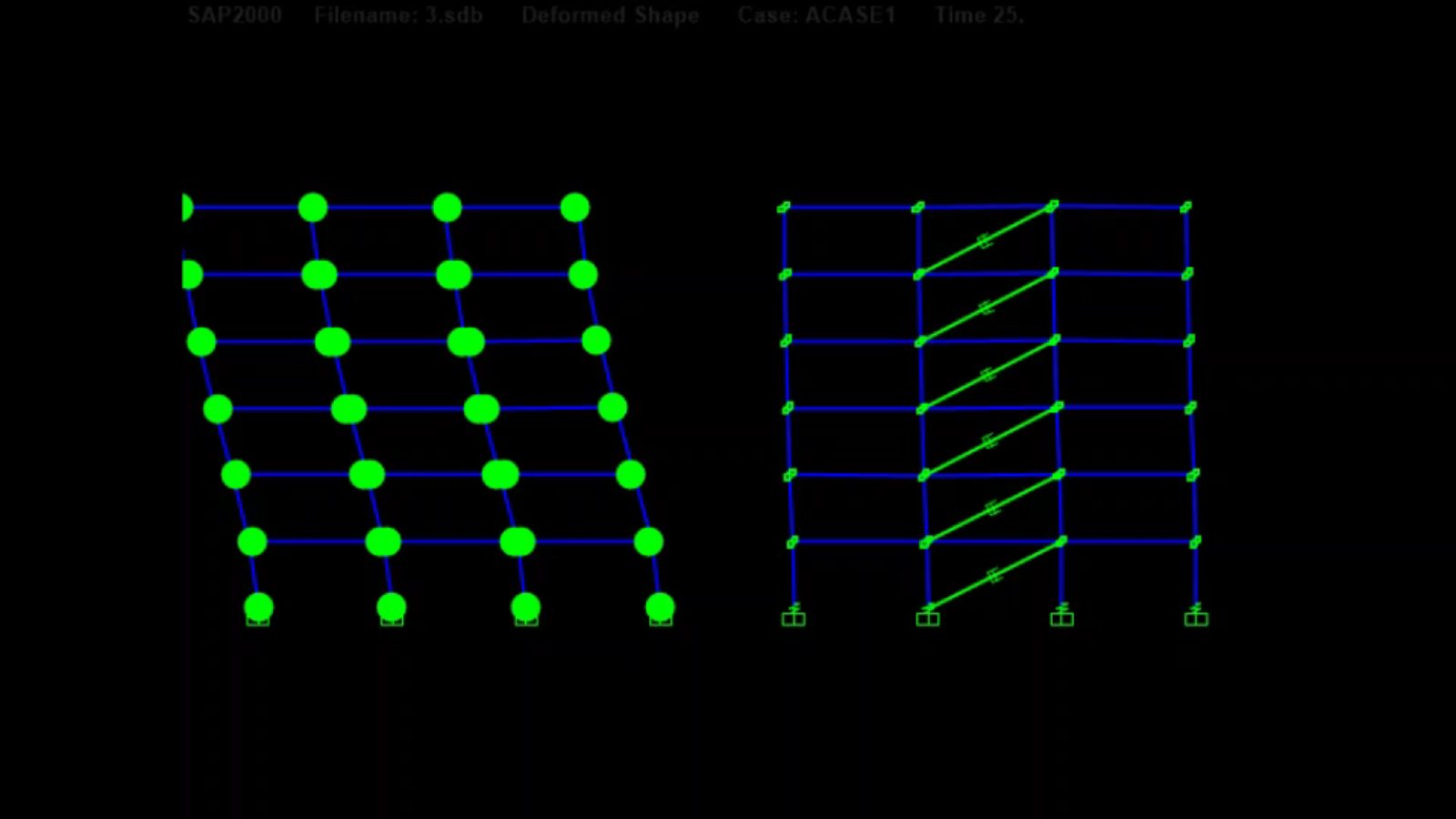
The model below is a high-ductility steel moment-frame building with viscous dampers, analysed with nonlinear time-history earthquake analysis.
Related notes: Lead Rubber Bearing (LRB) Isolator · Triple Friction Pendulum Seismic Isolator · Steel Building Performance Analysis · Resilient Slip Friction Joint
Originally published in 2021; revised in 2026.