This simulation looks at a relatively new seismic technology: the resilient slip friction joint.
Friction has long been used in earthquake-resistant design to turn kinetic energy, which is harmful to the structure, into heat.
Friction devices have some weak points, though. Their load capacity is limited compared with other devices, and after displacing in an earthquake they may stick where they are and fail to return to their original position. Bringing the structure back then has to be done by hand, which is very costly, and if the structure cannot be straightened it may even have to be demolished.
Two structural engineers, Pierre Quenneville and Pouyan Zarnani, invented a seismic connection that removes these weak points of friction dampers: it stores the earthquake energy that pushes the structure out of balance, and uses it after the earthquake to bring the structure back to its original position.
How it works
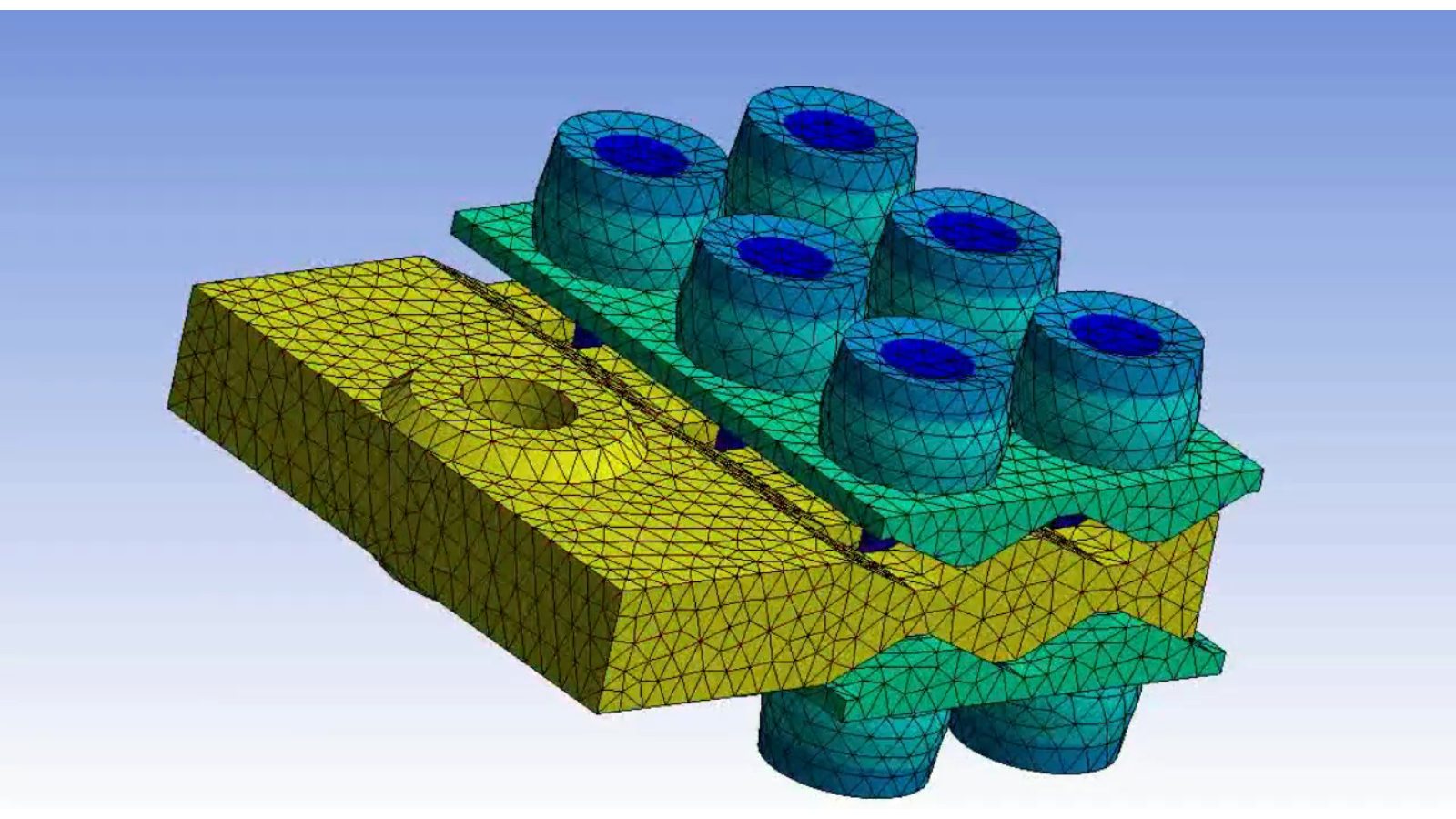
When the force on the middle plate exceeds the friction between the plates, the middle plate slides sideways and, through its saw-tooth profile, pushes the upper and lower plates apart, perpendicular to its movement.
The upper and lower cover plates compress the disc springs on top of them. The earthquake energy is stored in the springs as potential energy for later use, and the excess kinetic energy is released harmlessly as heat.
When the earthquake ends, the compressed springs move back elastically and return the upper and lower plates, and with them the middle plate, to their original position.
All parts stay below their elastic limit, and the sliding surfaces are lubricated to prevent wear, so no repair or replacement is needed after an earthquake. Aftershocks, or even larger earthquakes, do not put the structure at risk.
The simulation
In the example simulation, the middle plate is pulled 20 mm twice and then released, to examine the self-centring behaviour of the joint. The flag-shaped hysteresis curve shows that the joint self-centres.
Related notes: Lead Rubber Bearing (LRB) Isolator · Triple Friction Pendulum Seismic Isolator · Viscous Damper Reinforced Building Analysis and Design · Steel Building Performance Analysis
Originally published in 2022; revised in 2026.