The problems with the R factor have been discussed for many years. Describing the earthquake behaviour of a structure made of hundreds of columns and beams and thousands of joints with a single factor is too good to be true.
When the axial load on a column increases, for example, its ductility decreases. How, then, can a ground-floor column and a fifth-floor column be analysed with the same R factor? Can a long beam and a short beam in the same building have the same ductility? Does the ductility of the panel zone, where columns and beams of different sizes meet, not change throughout the structure?
How can we be sure that the plastic hinges formed in an earthquake will spread evenly through the structure, as the R factor assumes? What if, as the American engineer Dirk Bondy has been trying to explain for years, all the hinges concentrate in the first storey and push the structure into a mechanism?
An example
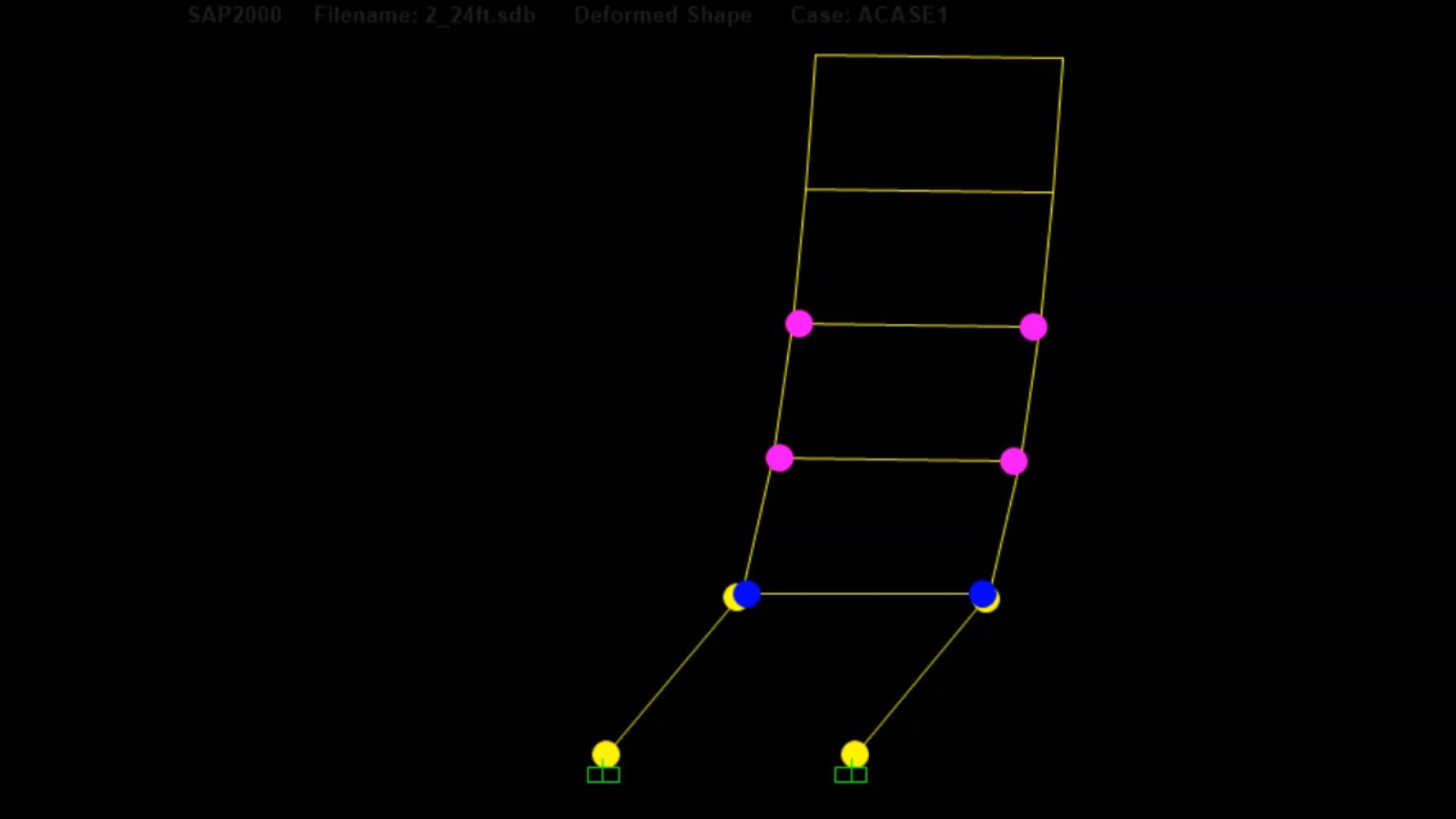
In the example below, a five-storey building was analysed with the equivalent lateral force method, and every code rule, including strong column–weak beam, was applied. At step 7, before the roof reaches 2% drift, hinges form at both the bottom and the top of a ground-floor column. Under the code, hinging at the base support is acceptable, but to avoid a mechanism the other hinges must form in the beams. At the top of the ground-floor column, the moment diagram shifts to one side in a way that a linear analysis cannot capture.
Looking at how structures collapse in earthquakes: besides weak-storey and soft-storey irregularities, could hinges like these also be a cause?
What a performance analysis adds
In a performance analysis, additional properties are defined at the points where hinges are expected to form in an earthquake. Every beam, column, brace, connection zone and so on is assessed separately for ductility.
The results show the performance of every member at any earthquake level, so the weak and critical points of the structure come to light, and they can be strengthened where needed.
For any earthquake, it becomes clear whether the structure can be used immediately afterwards, how much damage it will take, and whether that damage can be repaired.
Related notes: Viscous Damper Reinforced Building Analysis and Design · Lead Rubber Bearing (LRB) Isolator · Triple Friction Pendulum Seismic Isolator · How High Can Earthquake Ground Acceleration Go?
Originally published in 2021; revised in 2026.