The internal forces in a structural member (axial force, shear and bending moment) interact with each other in the limit states that govern its strength and stiffness. A few examples:
- The moment capacity of a column depends on the axial load it carries.
- The tensile strength of a bolt depends on the shear force acting on it.
- The stiffness of a cracked concrete section, or the stiffness reduction applied to steel members, depends on the axial force.
- Yielding or fracture of weld metal or a plate depends on the type and magnitude of the stresses in it.
The load combinations in design codes are written to capture the most critical of these interactions, based on past experience and possible future scenarios, while keeping the design economical.
What goes wrong with the envelope
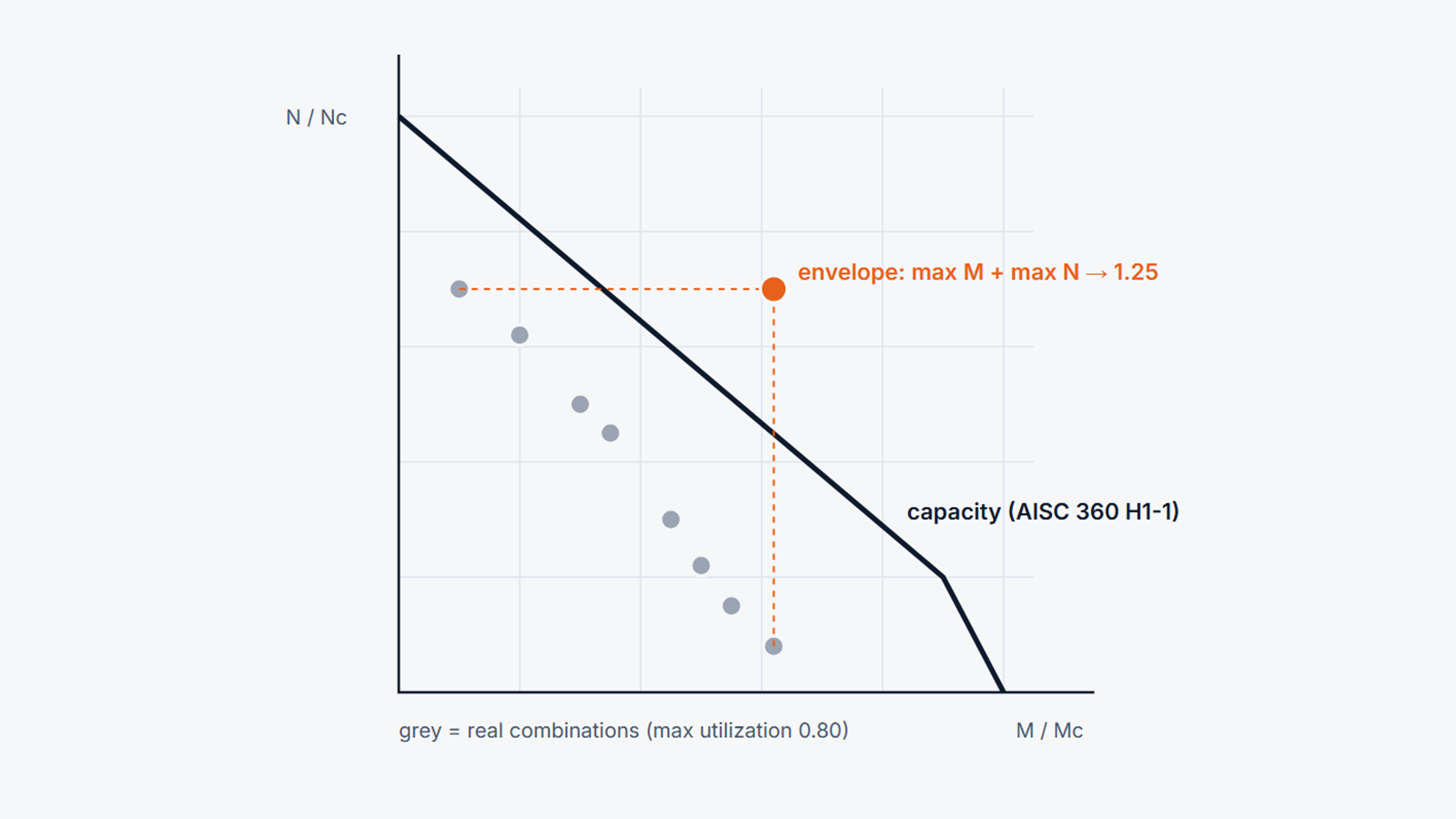
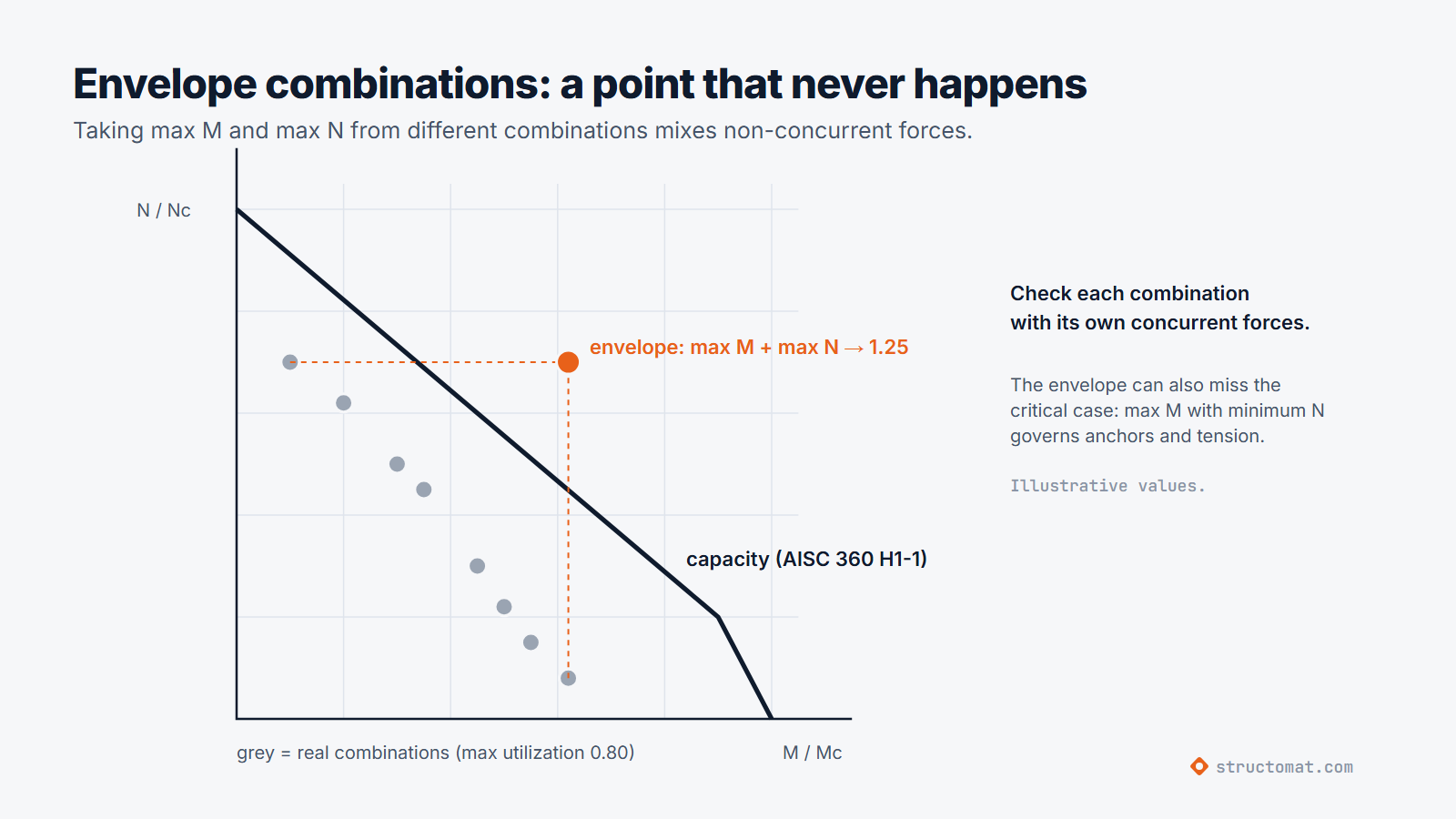
An envelope combination gives the maximum and minimum of every internal force, but these values come from different combinations. That makes the envelope of little real meaning for design:
- It is very unlikely that all the extreme values occur at the same time.
- Even if they did, there is no guarantee that combining them gives the most unfavourable interaction. A maximum moment with a minimum axial force, for example, can govern anchor bolts or members in tension; pairing the envelope’s maximum moment with its maximum axial force misses that case entirely.
- Equilibrium is not satisfied at supports and joints. A calculation that does not satisfy equilibrium is wrong from the start.
The remedy is simple: check every combination with its own, concurrent set of forces.
Related notes: How High Can Earthquake Ground Acceleration Go? · Tension-Only Bracing Systems · Should the Bottom Chord of a Roof Truss Be Laterally Restrained? · Column Base Plate: Hinged or Fixed Connection?
Originally published in 2021; revised in 2026.