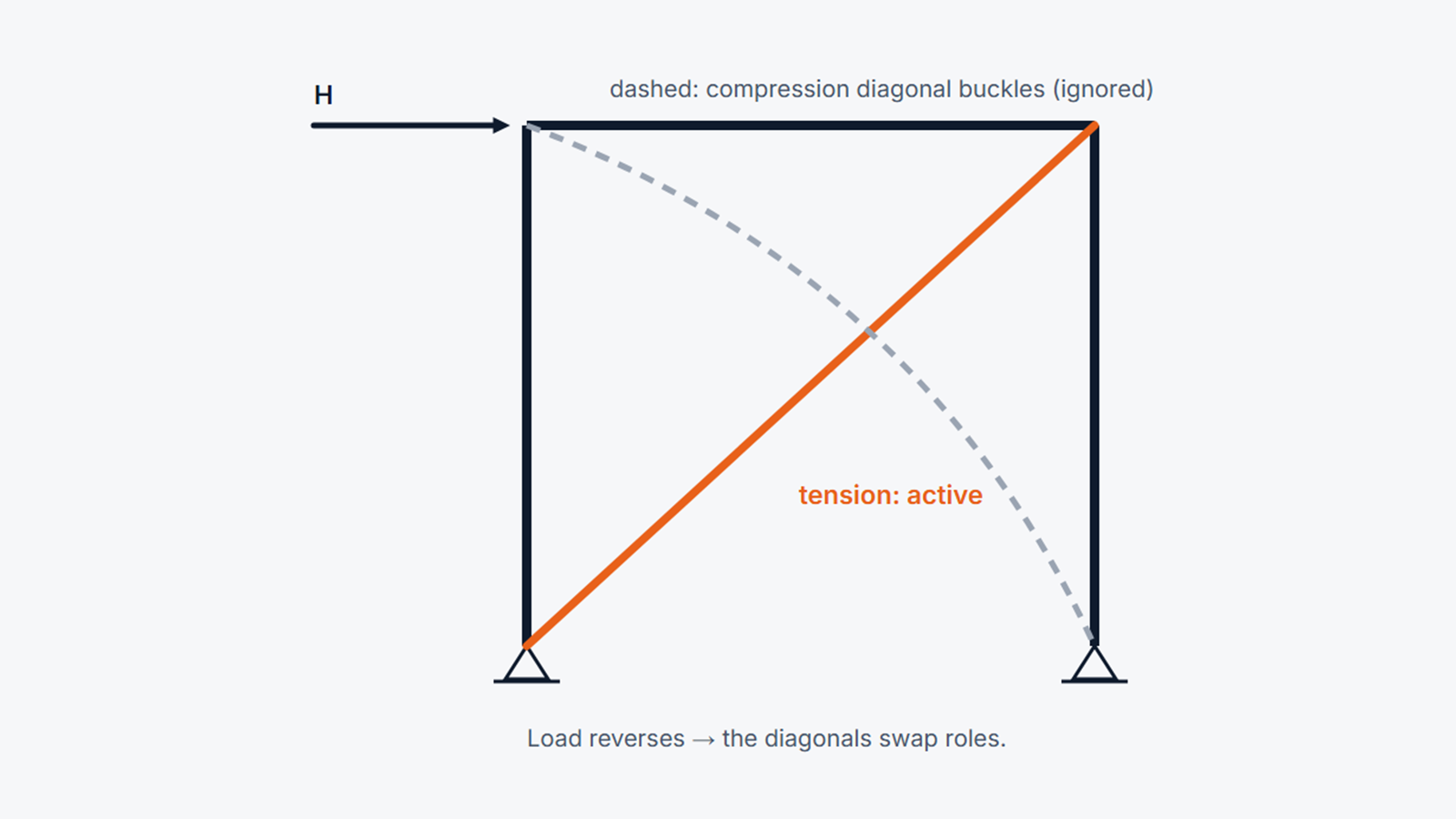
In concentrically braced steel frames of limited ductility, seismic codes permit braces that work in tension only. Codes that allow them typically limit their slenderness ratio (L/r) to 300.
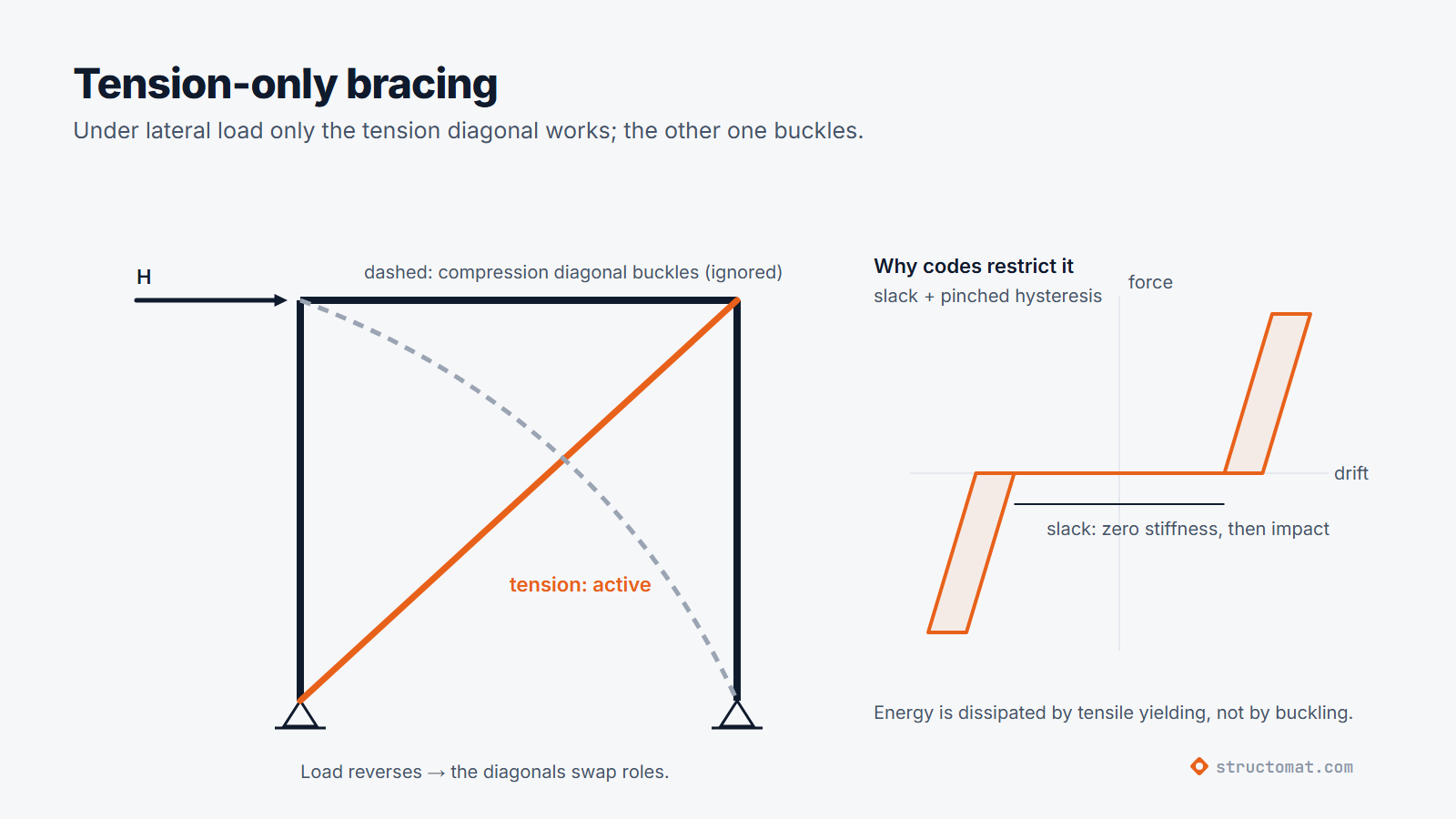
Why the brace has to be slender
The analysis model assumes that the brace carries tension only. For this assumption to hold during cyclic loading such as an earthquake, the brace must be slender enough to buckle elastically, without damage, when it is pushed into compression. A stockier brace buckles inelastically: it is damaged, and its tension capacity drops as well.
For this reason a minimum slenderness ratio of about 200 is recommended for tension-only braces. Together with the code limit, the practical range is roughly 200 ≤ L/r ≤ 300.
Three more things to keep in mind
- Energy is dissipated by tensile yielding, not by buckling. A brace that has yielded is permanently longer. On the next cycle it carries nothing until this slack is taken up, and then it is loaded suddenly. The result is a pinched hysteresis loop and impact on the connections, which is the main reason codes restrict tension-only systems.
- Capacity design for the connections. Design them for the brace’s expected tensile strength, so the brace yields before the bolts or the gusset plate fail.
- Codes control slenderness in different ways. Eurocode 8, for instance, uses non-dimensional slenderness: 1.3 < λ̄ ≤ 2.0 for X-bracing where only the tension diagonals are counted. Always follow the code that governs your project.
Related case study: A crane canopy: three support decisions and the traps between them — a ‘tension-only’ brace left in a linear load combination carried 55 kN of compression and showed a false failure; it disappeared once the combinations were nonlinear.
See it in a real model: every member of a designed canopy, coloured by its design ratio. Brace connections designed for the expected tensile strength: Steel connection design and calculations, outsourced.
Related notes: The Concept of Envelope Combinations and Their Limitations · How High Can Earthquake Ground Acceleration Go?
Originally published in 2020; revised in 2026.