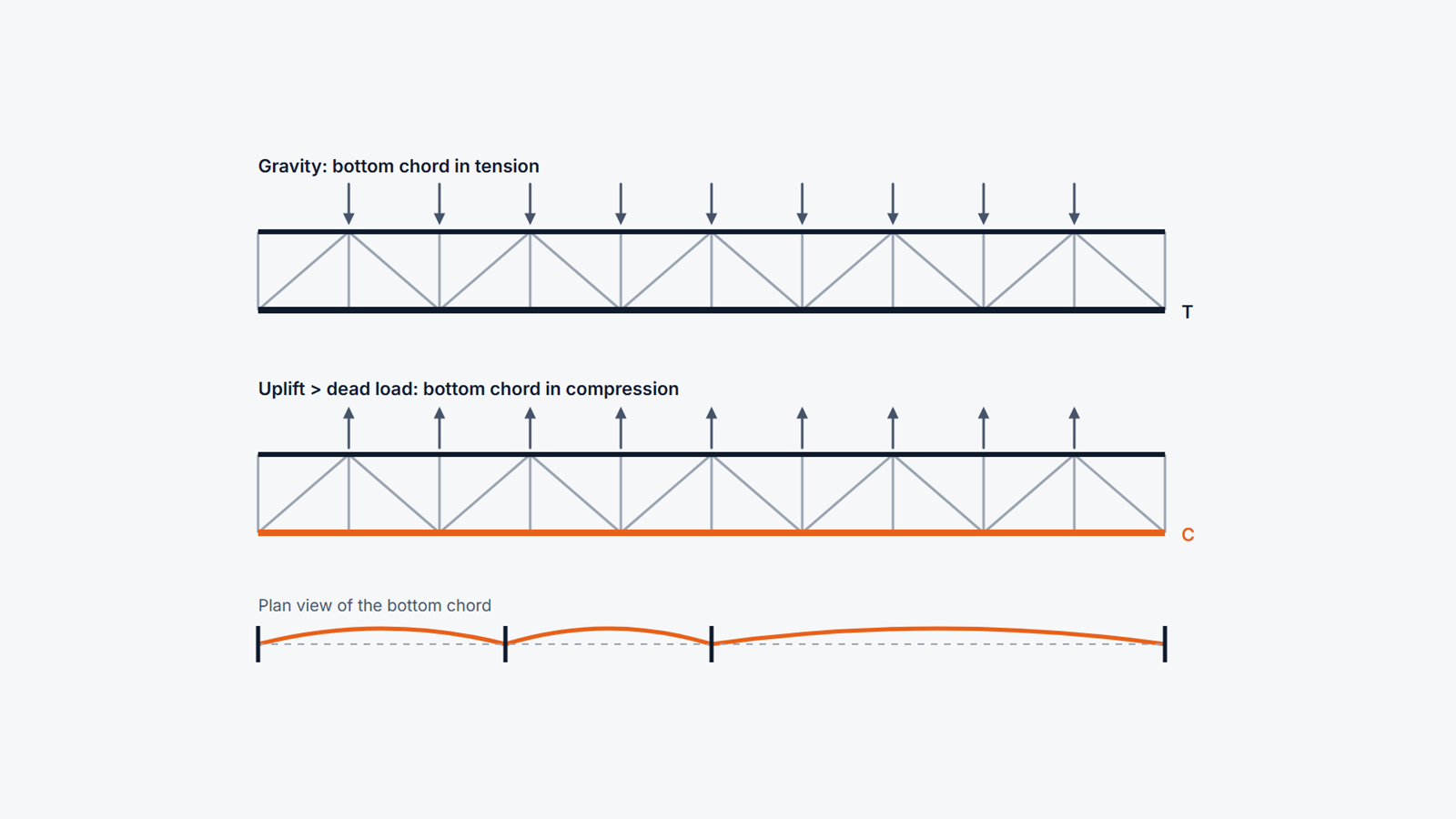
In theory, the bottom chord of a roof truss does not need lateral restraint if it never goes into compression, that is, if the wind uplift is not large enough to exceed the self-weight of the roof.
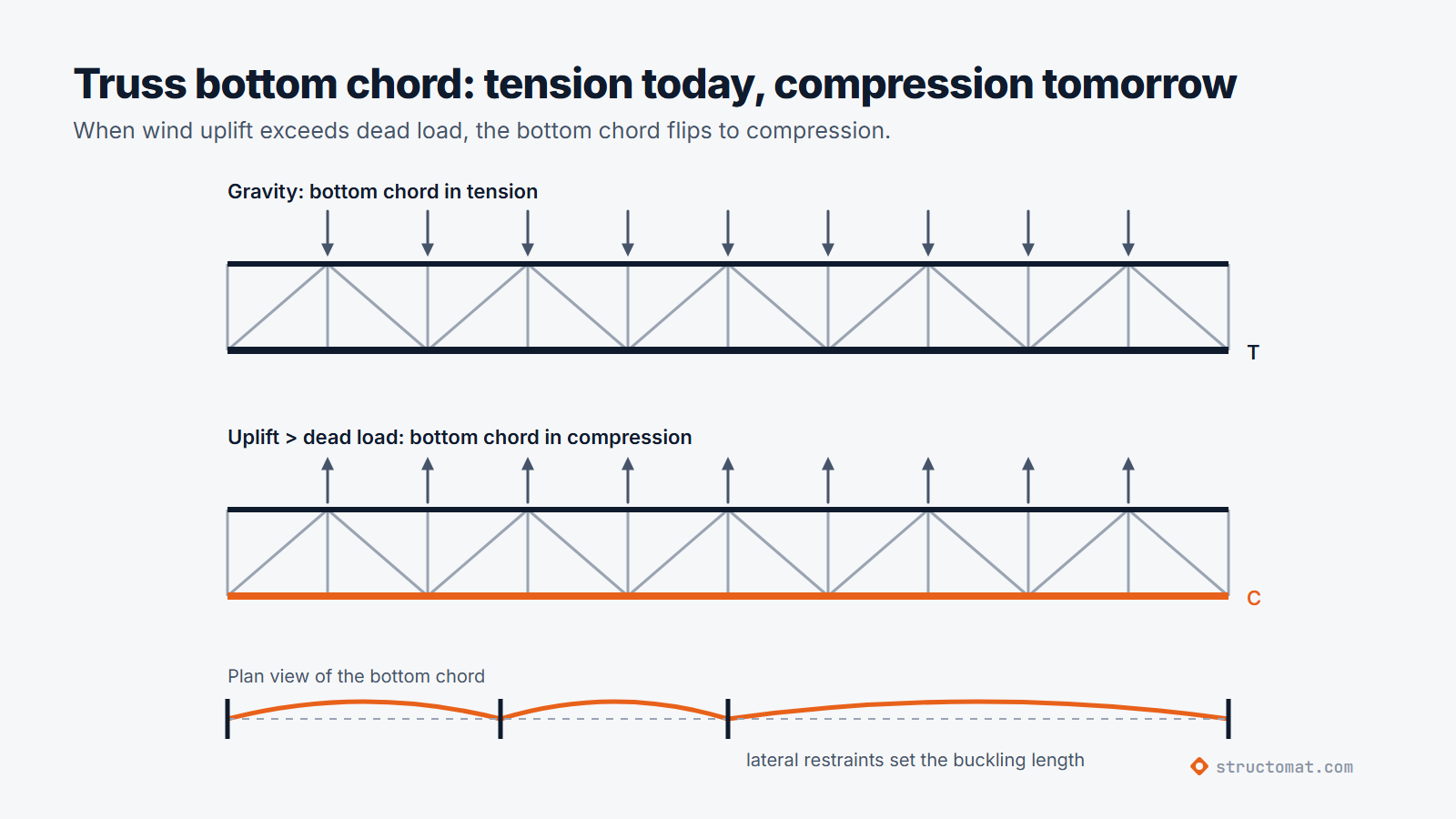
In practice, and especially for long-span trusses, the slenderness of the bottom chord for out-of-plane buckling should still be checked: L/r should not exceed 300. This limit applies in every case, whatever the stress state.
There is a second reason. The compression diagonals of the truss are connected to the bottom chord, and their buckling length is calculated assuming pinned supports at both ends. The bottom chord must therefore be strong and stiff enough to make that assumption true.
In short
- Bottom chord never in compression: lateral restraint is not required for strength.
- Uplift greater than dead load: the bottom chord is in compression. Provide lateral restraints (bottom-chord bracing or fly braces) and check buckling between them.
- Always: out-of-plane L/r ≤ 300, and enough stiffness to support the compression diagonals.
- Trusses rigidly connected to their columns deserve a separate look: frame action can put the bottom chord near the supports into compression even without uplift.
More from real projects: Case studies — steel projects told in the order they happened: where the input came from, what broke, what the engineer decided, with the numbers.
Planning a truss roof? Steel farm buildings: sheds, barns and machinery stores · Extending a roof with a steel structure · Walk inside a real steel hangar in 3D.
Related notes: The Concept of Envelope Combinations and Their Limitations · Steel Silo Analysis and Design
Originally published in 2020; revised in 2026.