

Steel connection library
28 steel connections, each checked plate by plate in a finite element model: base plates, knee joints, splices, bracing gussets, truss nodes and hollow section joints. Each page has the members, bolts, welds, the utilisation of every component and a 3D model you can rotate. Standard connections can be checked instantly below.
Connection design · 28 from real projects
Connections I can check instantly
Pick one to check it below. More types and sizes are added as they are validated.
Instant check · standard connections
Check a standard connection in seconds
Pick a connection type and the member sizes, enter the forces at the member end and get the utilisation, the component that governs and the plate and bolt layout.
Design (factored) member-end forces at the node (the dot on the drawing), shown as arrows as you type. The node is on the centreline of the column or main beam, where a frame analysis gives the forces (not at its face). The beam acting on the connection: N + pulls the beam away (tension), Vz + upwards (gravity shear is negative), My + puts the top flange in tension.The column acting on the base: N + uplift (tension), Vz along the web, Vy along the flanges. Pinned connection: no moment.
The forces are sent to compute the result and are not stored. AI assistants can run the same check with the check_connection tool of the Structomat MCP server.
The result appears here: utilisation, governing component and the connection detail.
The library
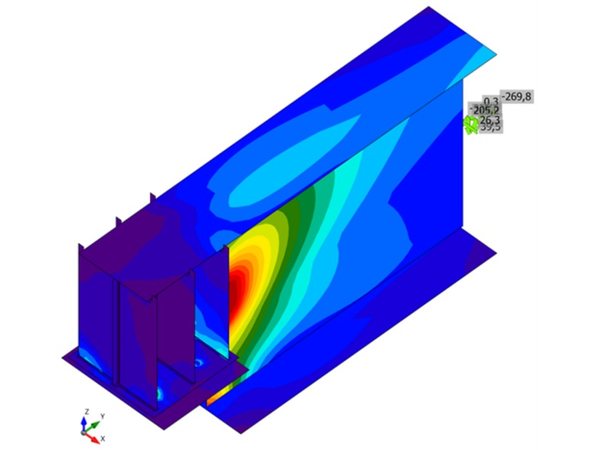 Column bases
Girder bearing on concrete: welded I 1200 on an anchored base
AISC 360-16 · Welds 77 % of capacity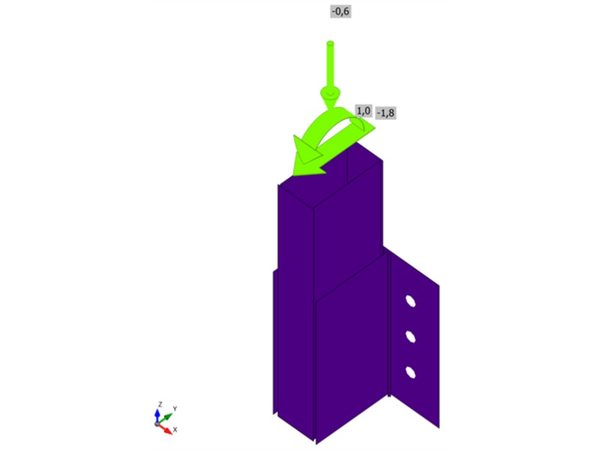 Column bases
RHS 100×50 post anchored to the side of a concrete wall
AISC 360-16 · Anchors 37 % of capacity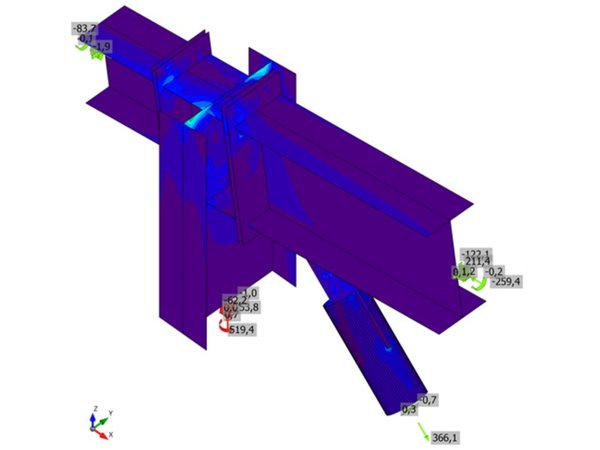 Beam-to-column and knee joints
HEB 400 beams over an HEB 600 column with a CHS brace
AISC 360-16 · Bolts 92 % of capacity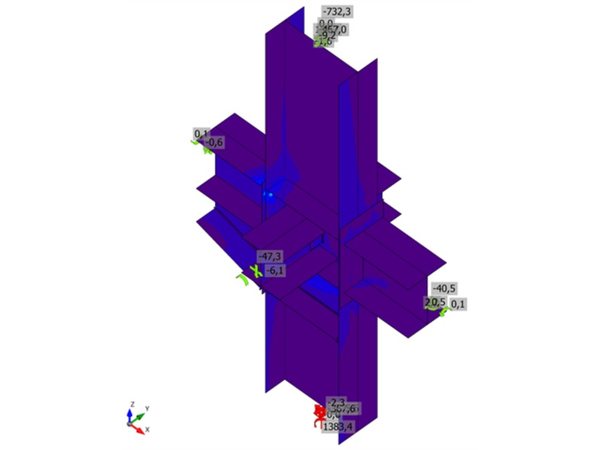 Beam-to-column and knee joints
HEB 400 and HEA 300 beams on an HEB 600 column
AISC 360-16 · Bolts 87 % of capacity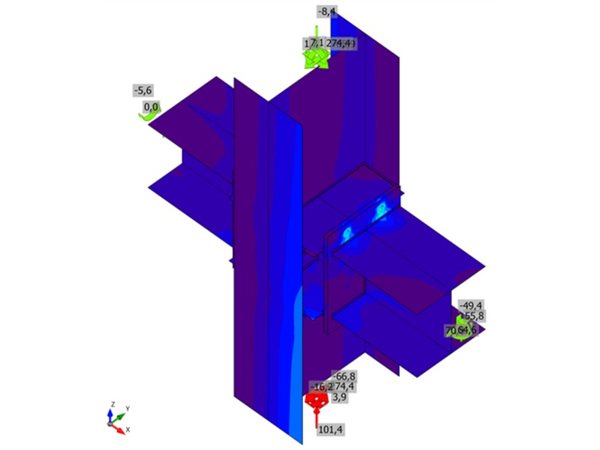 Beam-to-column and knee joints
Two HEA 300 beams on an HEB 450 column through welded stubs
AISC 360-16 · Bolts 83 % of capacity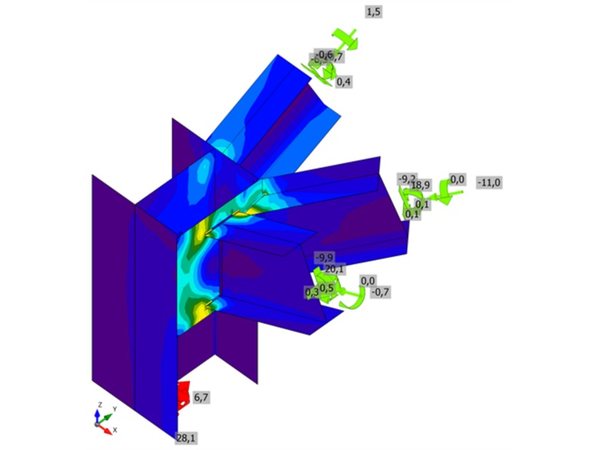 Beam-to-column and knee joints
Welded knee: IPE 240 rafters on an HEB 300 column
AISC 360-16 · Welds 83 % of capacity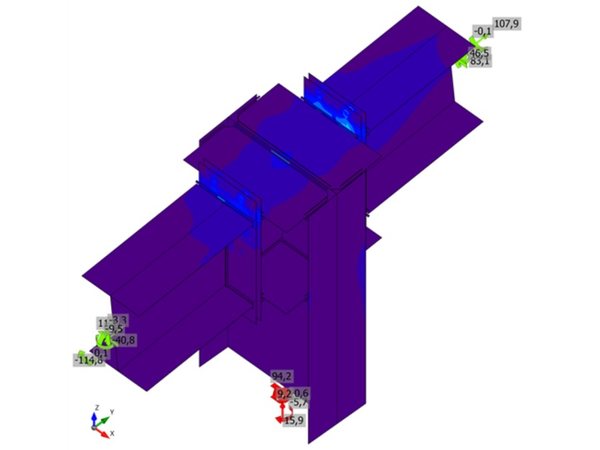 Beam-to-column and knee joints
HEB 450 beams on an HEB 600 column
AISC 360-16 · Welds 76 % of capacity Beam-to-column and knee joints
Four-way beam-to-column node: IPE 300 beams on an HEB 240 column
AISC 360-16 · Welds 75 % of capacity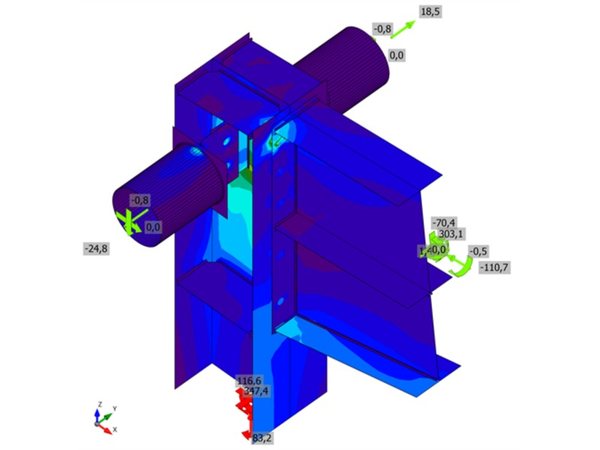 Beam-to-column and knee joints
Haunched IPE 400 beam on an HEA 340 column with a tubular brace
AISC 360-16 · Welds 69 % of capacity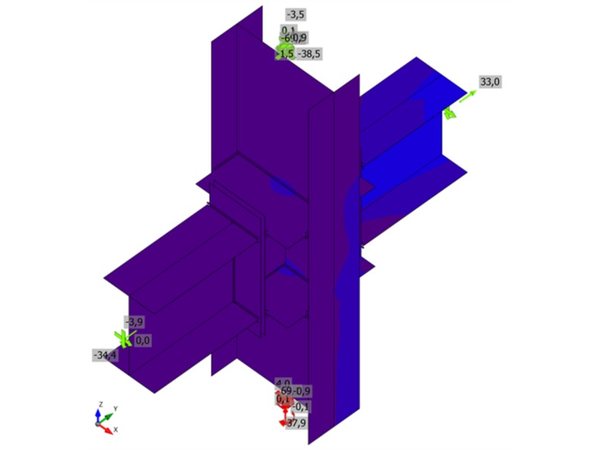 Beam-to-column and knee joints
HEA 500 beams framing into an HEB 600 column
AISC 360-16 · Welds 29 % of capacity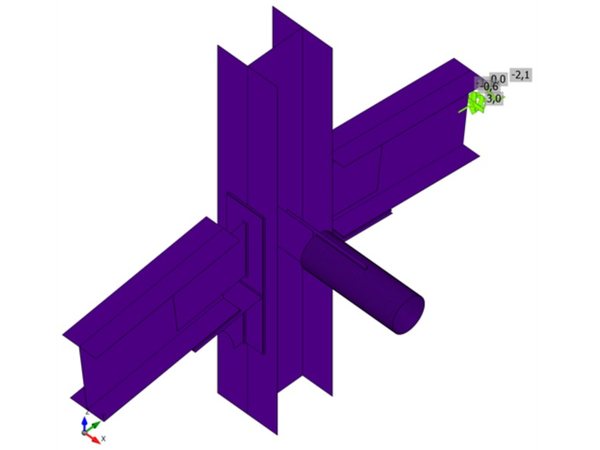 Beam-to-column and knee joints
IPE 360 beams on an HEA 300 column
AISC 360-16 · Welds 21 % of capacity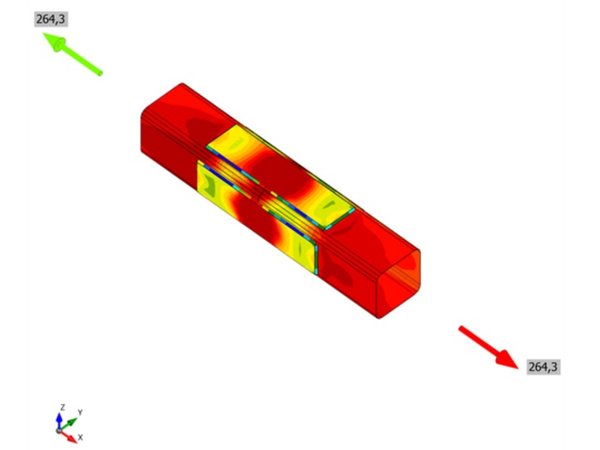 Splices
Welded sleeve splice of an SHS 80×80×5 in tension
AISC 360-16 · Welds 93 % of capacity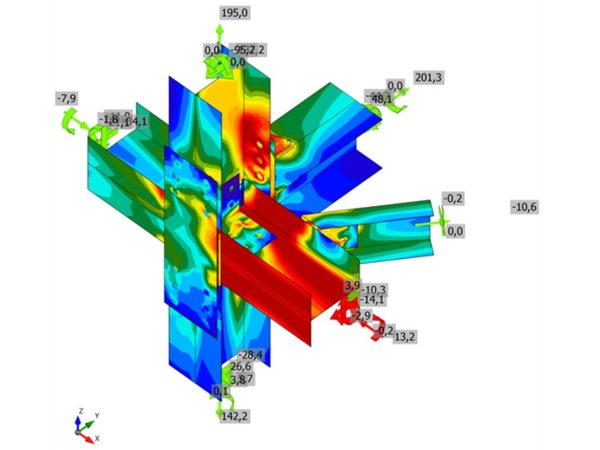 Bracing and gusset nodes
Column node with UPN 160 and angle braces on an HEB 200
AISC 360-16 · Bolts 95 % of capacity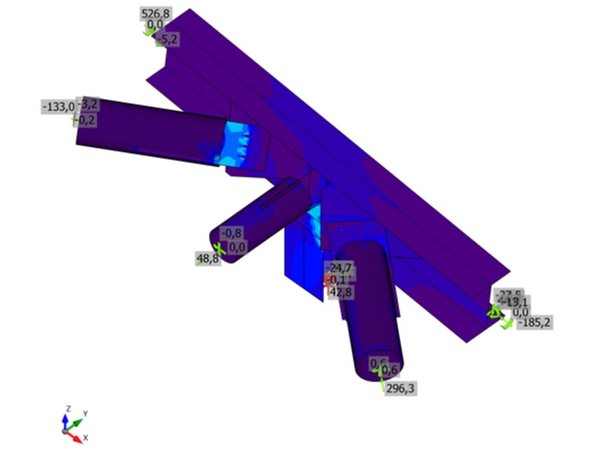 Bracing and gusset nodes
CHS 219.1 braces on an HEB 400 through a gusset plate
AISC 360-16 · Welds 86 % of capacity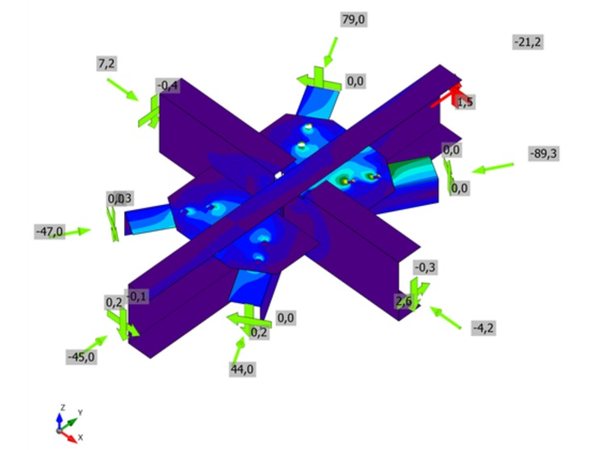 Bracing and gusset nodes
Cross node: UPN 200 members with angle braces
AISC 360-16 · Bolts 83 % of capacity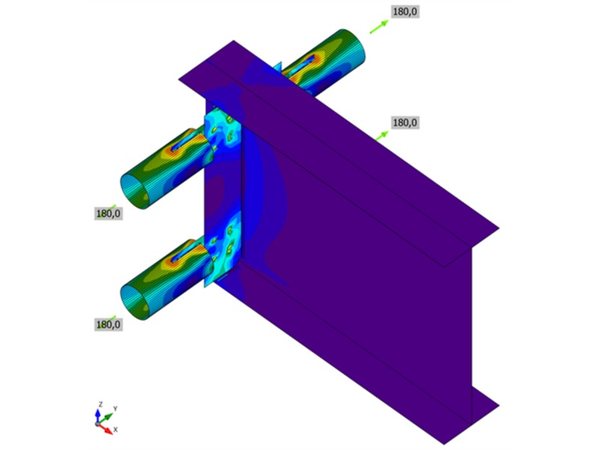 Bracing and gusset nodes
Tubular braces bolted to the web of a deep girder
AISC 360-16 · Welds 76 % of capacity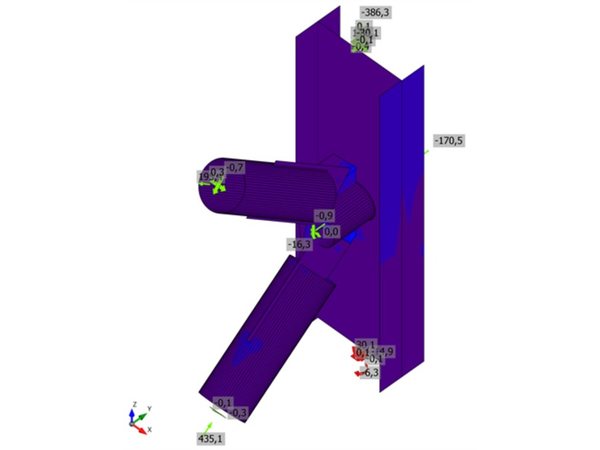 Bracing and gusset nodes
CHS 219.1 braces on an HEB 600 column
AISC 360-16 · Welds 76 % of capacity Bracing and gusset nodes
Bracing node at an HEA 240 column with an IPE 360 beam
AISC 360-16 · Welds 75 % of capacity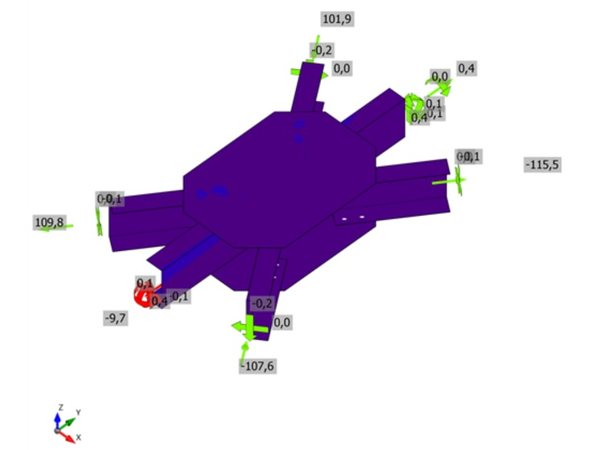 Bracing and gusset nodes
Horizontal bracing node: four UPN 160 on one gusset plate
AISC 360-16 · Bolts 68 % of capacity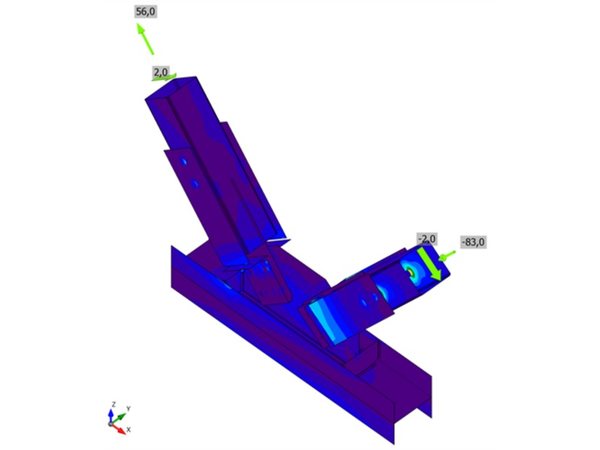 Bracing and gusset nodes
Bolted brace node: SHS 120 braces on an HEA 160 beam
EN 1993-1-8 · Bolts 34 % of capacity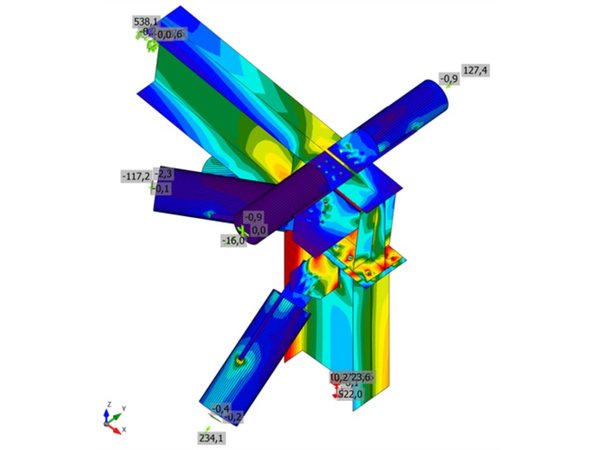 Truss and lattice nodes
Truss seat on an HEB 600 column with CHS braces
AISC 360-16 · Bolts 83 % of capacity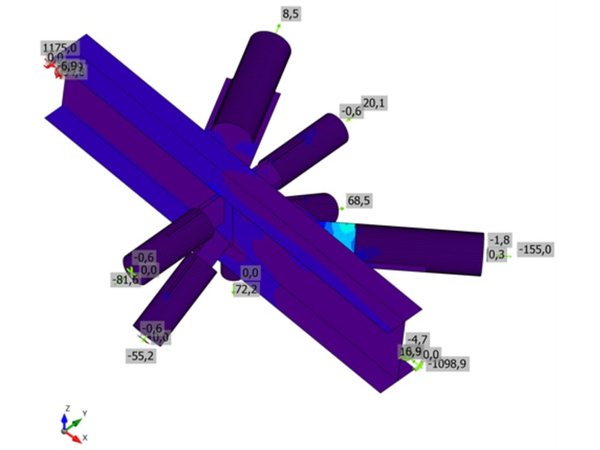 Truss and lattice nodes
Lattice node: CHS 219.1 braces on an HEB 600 chord
AISC 360-16 · Welds 77 % of capacity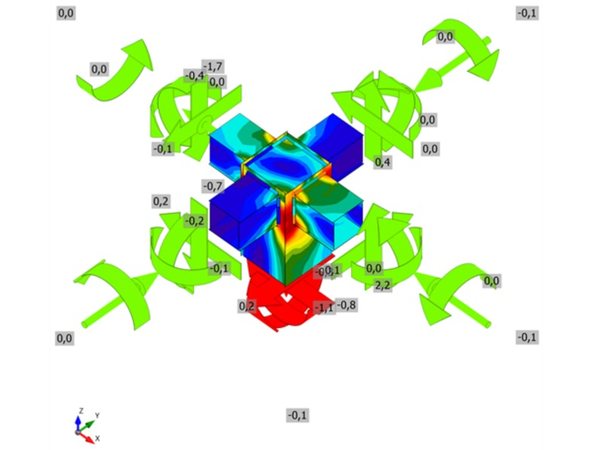 Hollow section joints
Welded node of SHS 60 and SHS 40 members
AISC 360-16 · Welds 80 % of capacity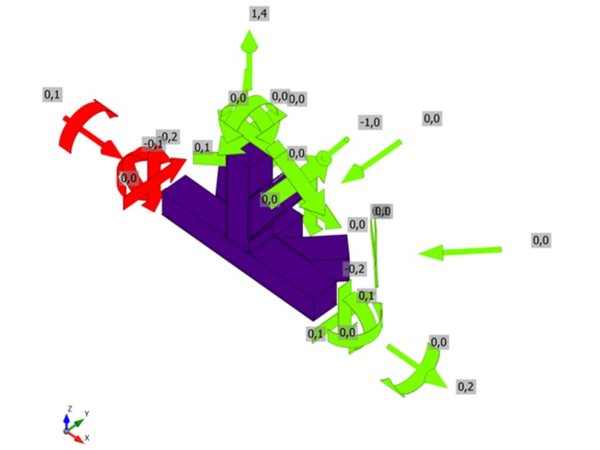 Hollow section joints
Welded multi-member node in SHS 40×40×2.5
AISC 360-16 · Welds 10 % of capacity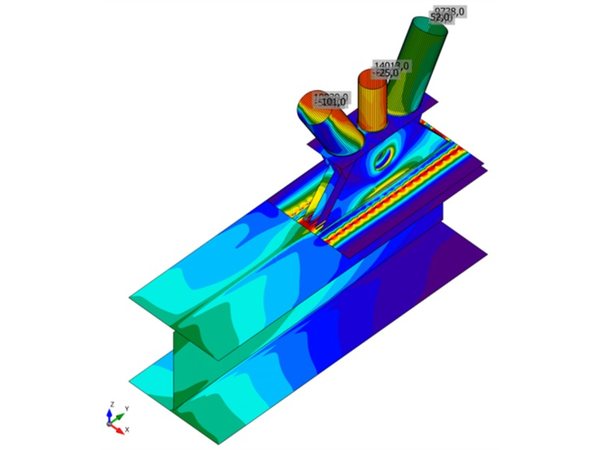 Special and multi-member nodes
CHS 914 and CHS 711 struts on a plate girder with M52 bolts
EN 1993-1-8 · Bolts 95 % of capacity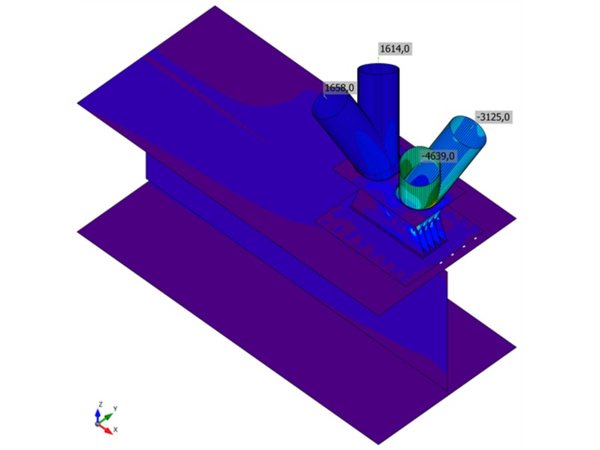 Special and multi-member nodes
Four CHS 660 struts on a deep plate girder
EN 1993-1-8 · Bolts 83 % of capacity Special and multi-member nodes
Steel collar on a concrete column carrying an HEB 400 beam
AISC 360-16 · Welds 78 % of capacity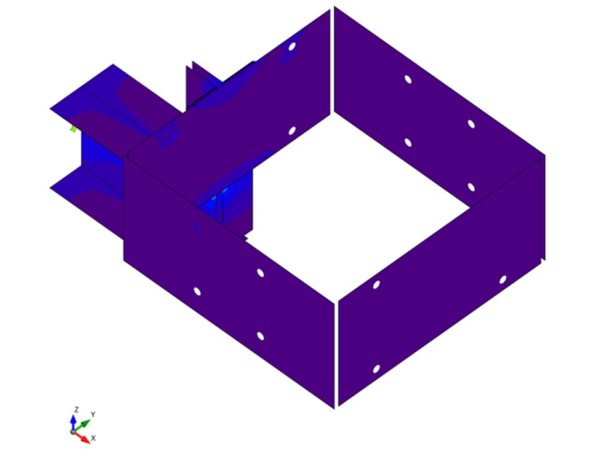 Special and multi-member nodes
HEB 400 beam seat on a concrete column with anchored side plates
AISC 360-16 · Welds 76 % of capacityFAQ
About this library
Are these real connections?
Yes. Each one was modelled and checked for a real structure or, where marked as a worked example, for a training model. The numbers on each page are read from the check report, not typed in.
How is a connection checked?
Every plate, bolt and weld is modelled in a finite element model of the joint (the component-based finite element method, CBFEM). Plates are checked against a plastic strain limit, and bolts, welds and anchors against the resistances of the design code.
Which design codes?
The pages show the code each connection was checked to, mostly EN 1993-1-8 and AISC 360-16. Other codes are possible; ask at the start.
Can you design a connection like one of these for my project?
Yes. Send the member sizes and forces, or the analysis model, and you get a written scope and price before any work starts.
How does the instant check work?
Each standard connection was analysed in advance with the same finite element method used for this library, for the member sizes listed. The check compares your forces with those results and returns the utilisation and the component that governs.
When does the instant check not apply?
When another member (a brace, a second beam) connects at the same node, when the sizes or the plate layout differ, or when the design is for construction. Then the connection is designed and checked for the project, with its report.
Have a connection to design?
Send the member sizes and forces, or the analysis model. Simple or complicated, every plate and bolt gets checked.
info@structomat.com You get a written scope and price before any work starts.