Steel silos are important engineering structures that store many different materials: grain, cement, sand, coal and more. Depending on their purpose and location, they come in a wide range of sizes, capacities and types.
A steel silo can sit directly on a concrete slab on the ground. When the silo has to empty completely, with the stored material flowing out naturally under gravity, it can instead be raised on supporting steel sections. Conical hoppers are then added under the main body to give the required rate and pattern of flow.
The main body can be made of flat steel plates, welded or bolted, or of profiled (trapezoidal) steel sheet. Profiled sheet only has the capacity to resist the tension caused by the pressure of the stored material on the walls, so additional cold-formed light steel sections are needed for the other forces.
Why silos are difficult
Large elevated steel silos in particular are very complex structures. That is why, even in 2020, they were still among the structure types that suffer the most damage and collapse.
The unit weight of the stored material and the forces it applies to the walls depart from their characteristic values because of temperature, moisture, compaction and so on, so calculations are made for both lower and upper values. During filling and discharge these forces change constantly and dynamic effects appear; they are taken into account with factors. The geometry of the conical hopper determines the type of flow inside the silo, and the stresses in the main body and the hopper are calculated for that flow type. Tensile, compressive and shear stresses vary continuously around and along the silo. Tensile stresses push the material towards yielding, while compressive stresses cause stability problems before yield is reached.
Imperfections in the silo wall have a strong influence on stability, and they must be included in the calculation at values within the code tolerances. Boundary conditions are also very important: the distribution and size of the stresses change with the stiffness of the connection between the supporting structure and the silo body, and with the design of the silo roof. Even a one-degree slope in the ground can upset the balance of the whole structure.
Like many other structures, steel silos are exposed to snow, wind, earthquake, temperature, corrosion and so on, and must be sized for these actions too. When the silo is empty, there is no stored material to counteract the wind pressure on the wall, so buckling becomes easier.
Because of the mass of the stored material, large silos are very heavy structures. The supporting structure and the silo walls together may carry loads of up to dozens of times their own weight.
With today’s technology a silo cannot sense an earthquake in advance and empty itself in a few seconds, so the supporting structure must also resist the large horizontal and vertical forces from these heavy masses. As if that were not enough, the stored material behaves like a fluid, so in an earthquake it strikes the silo walls and creates additional stresses in them.
The example model
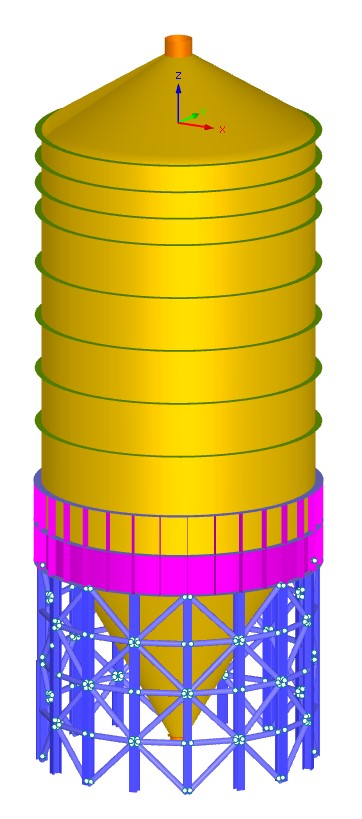
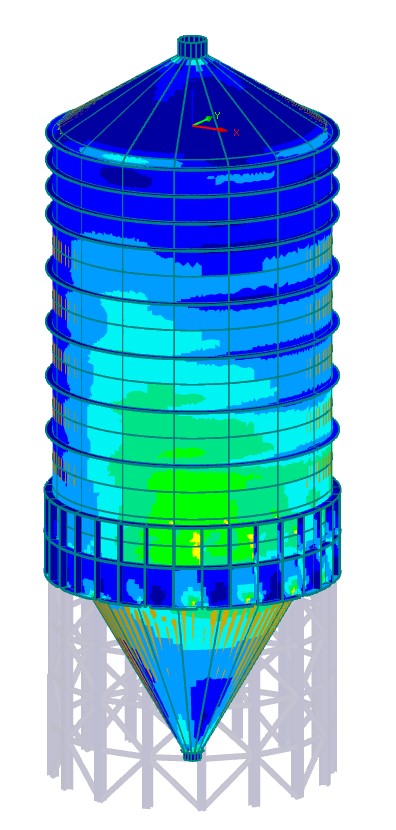
The model below is an elevated steel silo for 1,000 m³ of maize, to Eurocode. Below: the 3D model, and the stresses under earthquake loading.
Related notes: Should the Bottom Chord of a Roof Truss Be Laterally Restrained? · The Concept of Envelope Combinations and Their Limitations
Originally published in 2021; revised in 2026.